BRAVE DICK DOWLING
In 1845, nine years after San Jacinto, Texas joined the great American Union. The Lone Star flag gave place to the flag of many stars and stripes. War followed between the United States and Mexico. The United States won every battle, and in less than two years Mexico begged for peace.
For many years Texas was prosperous and happy. Her fertile soil and delightful climate attracted thousands of immigrants. Towns and cities sprang up everywhere. Great herds of cattle grazed on the western plains, and the fields of the east were covered with waving grain and snowy cotton.
Then came rumblings of another storm and war clouds, dark and fearful, settled down upon the country. For four long years the States of the South battled against the States of the North. What it was all about you may read in the history of the United States. Sometimes the victory was with one side and sometimes with the other; but at the last the South was beaten and had to give up. One of the South's greatest victories was won in Texas, and by Texas soldier boys.
Sabine Pass, September 8, 1863! Write it in letters of gold. Carve it high on monuments of stone. Grave it on the hearts of the people. A greater deed was never done since the world began.
Sabine Pass was one of the ports or doors through which the Confederacy, as the Southern States were called, sent its cotton to Europe and brought in supplies of arms and ammunition. It was very important to the South that this door should be kept open. The North knew this, and determined to close it as she had done other ports. Gun boats were stationed at the mouth of the Pass to prevent ships from going in or out.
The Sabine River, before it flows into the Gulf of Mexico, widens into a lake of some size. The outlet of the lake is known as Sabine Pass, or simply the Pass. About five miles from the mouth of the Pass the Confederates had built a small earthwork to guard the entrance, and to defend the State against invasion from this direction. One and a half miles farther up the channel was the town of Sabine Pass. Between the town and the fort was an impassable swamp. Through this swamp a narrow road had been built by which supplies might be brought to the fort. This road stood high out of the water, and could be seen for a long distance.
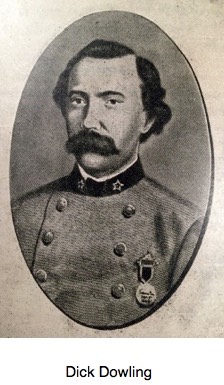
Fort Griffin, as the earthwork was called, mounted six slight guns and was garrisoned by the Davis Guards, a company of Irishmen from Houston. All told, there were forty-three men in the fort. Captain F. H. Odium at
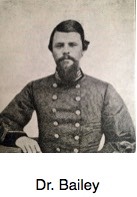
Sabine Pass was in command. Lieutenant Richard W. Dowling, or "Dick Dowling," as his men loved to call him, was in charge at the fort. He was scarcely twenty years of age, and looked a mere boy. Dr. George H. Bailey was post-surgeon, and Lieutenant N. H. Smith, engineer.
When General Magruder at Houston learned that the Pass was closed, he sent two cotton-armored gunboats, the Josiah Bell and the Uncle Ben, to open it up again. This they succeeded in doing, capturing two of the Northern gunboats, the Velocity and the Morning Light.
But the North had more ships and men than the South, and it was not long before the Pass was again closed. Moreover, an army was sent to capture Fort Griffin and to take possession of East Texas.
About midnight, on Sept. 6, 1863, the soldier on guard at the fort, as he looked toward the mouth of the Pass, saw an unusual sight. The flash of guns was plainly seen, but no sound was heard. Was it a battle? Had the Uncle Ben stolen out in the darkness and attacked the blockading ships? In some parts of the southern ocean atmospheric lights play around the masts of vessels.
Could it be these lights? Up and down the masts they go ; now a red one, then a green one, followed by a white one.
Greatly puzzled, the guard reported what he had seen to Lieutenant Dowling. Mounting the earthwork and look ing seaward, the Lieutenant saw at once the meaning of the lights. "Signaling!" he exclaimed, as he saw the lights racing after one another. Then re-entering the fort, he roused the sleeping soldiers. "Wake up; wake up, boys!" he cried cheerily, "There is something brewing and we had better go to work."
In an instant the men were on their feet and crowding around the lieutenant to hear the news and to take his orders. Pointing toward the ships, Dowling repeated his words, "There's something brewing and we had better go to work."
Suiting the action to the word, the men went to their several duties, and soon the fort was filled with the bustle of preparation. The guns were overhauled and primed, and, near each, heaps of powder and ball were piled: Dr. Bailey got out his splints and bandages; Lieutenant Smith, the engineer, went from gun to gun to see if they were properly mounted; while Dowling, by a flickering torchlight, studied a chart of the Pass.
With the earliest dawn every man was on the earth work, eagerly scanning the Pass for a glimpse of the expected enemy. But no enemy was in sight. It was a doleful company that sat down to breakfast that morning. Many faces were scowling and mutterings were heard about "losing sleep and having to work all night for nothing."
"Never mind, boys, never mind," said Dowling, trying to console them; "there is surely something brewing, and let us prepare for whatever may come."
The lieutenant was right. About ten o'clock, away toward the south a thin column of smoke was seen rising out of the water. Another and still others appeared, till five were counted. The smoke columns grew thicker and darker — they were moving toward the Pass. Then the funnel of a gunboat hove in sight; then another and an other, and the masts of ships — one, two, three, four, five. All day long they kept coming, till a perfect forest of masts and funnels obstructed the mouth of the river.
It was General Franklin's army of invasion — five gun boats, twenty-two troop ships, fifteen thousand soldiers. From Sabine Pass, Captain Odium sent a message to General Magruder, telling him of the arrival of the fleet and asking what should be done. General Magruder re plied that he thought it would be useless to try to hold the fort against such odds; that it would be better to spike the guns, blow up the fort and retreat; but that he would leave the matter entirely in the hands of Captain Odium and Lieutenant Dowling.
When the dispatch was handed to Dowling, he called his men together and read it to them. Then, in a few short, earnest words, he spoke of what would happen should they retreat — Texas at the mercy of the invader; her towns burned; her fields laid waste; her men imprisoned; her women and children helpless at the feet of the enemy, homeless and starving. "We can scarcely hope to win," he continued, "but we will give them such a check that they'll think twice before going any further. What do you say, men? Shall we retreat, or shall we stay and fight it out? "
"No, no, no! Fight, fight, fight!" shouted the men in a chorus.
"Then look to your guns," said Dowling. "See that everything is ready. The attack may begin at any moment."
There is little sleep in the fort that night. In the shadow of the coming conflict the men are restless and uneasy. Now they gather in little groups and in low, earnest tones discuss the situation. Now they climb the earthwork and watch the shifting lights of the fleet; now they examine the guns to see that they are ready; now they throw themselves on the ground and try to sleep.
At daybreak, September 8th, they were all on the earth work again, straining their sight in the direction of the fleet. There was much stir and commotion among the vessels. Each man, as he gazed, repeated to himself his leader's words, "There's surely something brewing."
Once more they examined the guns and then set about preparing breakfast. A fire was kindled; the coffee-kettle was singing merrily; and the tempting odor of broiled steak was just beginning to rise from the coals when — whir-r-r, z-z-zip —a cannon ball fell right in their midst, scattering the breakfast in all directions.
"Whew! is that the way you say good morning? Well, we'll just return your salute," said the brave Irishmen, and every man sprang to his gun. "Not yet, boys, not yet," said Dowling; "they are too far off, and we haven't a ball or a pound of powder to throw away."
It was the plan of the enemy first to destroy the road leading through the swamp to Sabine Pass, so that no help could come to the fort; the breakfast ball was the signal for the attack to begin.
There were fifteen or twenty sick soldiers in the hospital at Sabine Pass, and Dr. Bailey had spent the night there caring for them. He expected to return to the fort before dawn, but the condition of his patients was such that he could hot leave until sunrise. He heard the thunder of the guns, and longed to be back with the brave fellows in the fort. Perhaps some of them were already wounded and needed his services. At last his round of duties in the hospital was completed. Every sick man had been visited, and his wants carefully attended to.
And now for the fort! Gathering an armful of band ages and other things necessary for "first help," the Doctor started on a run down the seemingly doomed road. The fire from the ships had now become incessant. Shot and shell were rained upon the road. Here and there great gaps of earth were torn out by the bursting shells. The air was thick with dust and smoke. No man could hope to pass through this leaden storm with his life. But, unmindful of danger, he hurried on.
His comrades in the fort see him coming. With breath less anxiety they watch his every footstep, and forget their own danger in seeing his. They shout to him and wave their hands. A shell bursting right in front of him hides him for a moment from view. It seems to have struck every man in the fort. They stagger back like drunken men and throw their hands in the air. Their faces are blanched with pain, and a cry as of mortal agony breaks from every lip — Have they killed him?
No; God be thanked! he has not been touched. He seems to bear a charmed life. Still clasping his roll of bandages and running with all his might, he emerges from the smoke and is soon nearing the fort.
The soldiers stretch their hands to him as the starving do for bread. They run to meet him. They clutch him in their arms. They wring his hand. They shout and laugh and weep by turns, and dance around him in their excess of joy.
About one o'clock in. the afternoon the gunboats began to advance. The Clifton led the way, closely followed by the Sachem, the Arizona and the Granite City. Slowly and cautiously they crept along, all their guns in action. Short work, it seemed, would be made of the little fort. It could not hope to withstand the enemy's fire at close range.
The fort's guns were old and almost unfit for use. The best one could not carry above a mile and a half, so not a shot had been fired.
Closer and closer crept the gunboats. By three o'clock the foremost was within hailing distance of the fort. Then in the intervals of the firing, the men on board could be heard shouting, "Come out of your hole, Johnny Reb;" "Come out and show yourself." "Why don't you speak to a fellow?" "Come over and take dinner with us."But there was no reply from the fort.
But, look closer. In the bomb-proofs, crouched down beside their guns, their fingers nervously clutching at the fuse, the brave Davis Guards impatiently await the order to return the gunboats' fire.
"Wait a little while, boys, just a little while longer, said Lieutenant Dowling, his smiling blue eyes fixed upon the advancing gunboats, and alighted fuse in his hand. "I'll give you the signal in a moment. You may fire when you hear my gun." Suddenly a sheet of flame leaps from the fort. In thundering tones the lieutenant's gun speaks out and a ball falls hissing into the water near the Arizona.
"Every man to his gun; No. 1, take aim, fire!" then "Load and fire at will," said Dowling, speaking rapidly, his face all aglow with the ardor of battle.
They needed no second bidding. Each man sprang to his gun with a will. Each knew his place and what was expected of him. There was little excitement and no fear All kept perfectly cool and worked their guns as. fast as human hands could work. They did not even take time to swab the guns, which became so hot that the hand could not be laid on them comfortably. And now the fight waxed fast and furious. Gun answered gun m one continuous roar. Boats and fort seemed wrapped in fire. Shells ploughed their way through the fort, tearing up the earth and filling the air with dust.
One ball from the ships struck the wheel of a gun carnage in the fort, knocking out one of the spokes. The piece hit the man who was working the gun, wounding him slightly. He stooped and picked up the spoke, and holding it out to Dr. Bailey, said, with a laugh, "Doctor, the Yanks are getting too familiar." No other man in the fort was hurt.
The boats fared worse. Their masts were shot away, their ropes cut, and great holes were torn in their sides. As if in horror of the work that was going on, the battle smoke, like a great white curtain, fell upon the scene and hid the combatants from each other.
Above the roar of the cannon an explosion is heard. It sounds like a mighty moan, and dies away in a fearful shriek. There is a lull in the firing. The smoke lifts for a moment, when the Sachem is seen to lurch forward and then fall heavily upon the water as a stricken thing. Clouds of steam and smoke are rising from her funnels. A ball from the fort has crunched through her side and exploded her boilers. A white flag is flying from her mast head, and she seems to be in great distress.
All the guns of the fort were now turned on the Clifton. Every shot took effect, and, in less time than it takes to tell it, she, too, had hauled down her colors. Then the Arizona came in for a pounding. She was already crippled and backing away out of range of the guns. To keep from sinking, she was seen to throw overboard horses, pro visions and everything that would tend to lighten her. The poor horses had halters tied around their forefeet and sank immediately. Some of the bacon and flour drifted ashore, where it was afterward picked up for use at the fort.
The battle was over. The troop-ships steamed away, and Texas was saved from the hand of the invader.
The Texans were astonished at the results of their vic tory. They had captured two gunboats and crippled a third; taken three hundred and fifty prisoners, thirteen cannon, many small arms and large quantities of ammunition and provision. On the gunboats three officers and ninety-four men were killed. The fort lost not a man.
The Sachem was towed to the wharf, but the Clifton had run aground, and could not be moved. The prisoners from both boats were taken to the fort. Captain Crocker, of the Clifton, was among the prisoners. Mounting the earthworks, he asked for the commanding officer. Begrimed with powder and covered with dust, Lieutenant Dowling presented himself. The Federal officer could hardly believe his eyes. This dirty boy his conqueror! It must be some jest, he thought. "And where are your soldiers?" he asked the Lieutenant. "Here," said Dowling, pointing to the men guarding the prisoners.
"Are these all?"
"All," said Dowling.
The officer hung his head and muttered to himself,
"Four gunboats and fifteen thousand men defeated by this boy and his forty-two Irishmen! It is something unheard of!"
Chapter 13 - Robert Edward Lee
==========