CABEZA DE VACA
Cabeza de Vaca, the head of a cow; what a strange name for a man!
Many, many years ago, before Washington was born, and before Columbus had discovered America, the kings of France and Spain were at war with the Moors, a heathen people who lived in Africa. With great armies they had crossed the narrow strait of Gibraltar and taken possession of the best parts of Spain.
A long and cruel war followed. But the Spaniards were not strong enough to drive them back. Then the French came to the help of the Spaniards. The two armies moved against the enemy. High mountains lay between them and the enemy's country. When they came to the mountains, they found all the passes strongly guarded by Moorish soldiers. In these narrow and dark passes One man could withstand a thousand. It would not do to risk a battle here.
The armies were about to return when a soldier presented himself to the king of France, and offered to show him a road through the mountains that was not held by the enemy. The soldier was sent with others to find and mark the pass. This they did by setting up at the entrance of the pass the skeleton of a cow's head. The armies passed through the mountains in safety and won a great battle over the Moors.
That his brave deed might never be forgotten, the soldier was made a knight and his name was changed to Cabeza de Vaca.
More than a hundred years before La Salle landed at Fort St. Louis, another Cabeza de Vaca made a wonderful journey across Texas and claimed the country for the king of Spain.' It is -the story of this wonderful journey that you are now to hear.
In the history of the United States you may read how the old Ponce de Leon, in search of the Fountain of Youth, discovered Florida, the beautiful "Land of Flowers," and claimed it for his master, the king of Spain.
In 1527 the king sent Narvaez, one of his best generals, to explore and settle the country. Narvaez took with him five ships and six hundred men. Cabeza de Vaca was commander of one of the ships. On the voyage they were caught in a dreadful storm and two of their vessels were lost. Cabeza narrowly escaped drowning.
When they landed in Florida, they found the country poor and the natives unfriendly. Not withstanding this they set out to look for gold and for a suitable place to make a settlement. Many difficulties beset them on the journey. Every step was dogged by Indians, who, from behind trees and fallen timber and from the shallow waters of lakes, where they stood nearly covered with water, attacked them with bows and arrows.
At two hundred yards the Indians seldom missed their aim. Their bows were eight feet long and as thick as a man's arm. A white man could hardly bend one. With those powerful bows they could drive an arrow deep into 1.110 bodies of great trees and quite through a man or a horse.
To add to their troubles, a strange sickness broke out mid spread rapidly through the army. Scarcely a man was fit for duty. Many died. Provisions were scarce and starvation looked them in the face.
The ships had been ordered to sail around the coast and. to wait for the army at the first good harbor that should be found. Party after party was sent out to search for the ships, but all returned unsuccessful, The truth of the matter was that the captain of the ships, concluding that Narvaez and his men had all perished, had set sail and returned to Spain.
What was to be done? To stay where they were meant death from sickness and starvation; to march farther inland, a worse death at the hands of. the Indians. The sea was their only way of escape. But the ships were gone! The land of flowers had become a land of mis fortune. What should be done!
They might build boats, but there was not a man in camp that knew even how to begin such a work. They had no tools, no iron, nor anything that was needed to build a boat. From sickness and lack of food, most of the men were too weak to work.
They must do or die. "Where there's a will there's a way" is an old and true saying. These men had the will to build boats, and the way to build them soon appeared.
From the iron of their stirrups they made axes and nails. Sails were made from the shirts of the men, and ropes from the manes and tails of the horses. Pitch was obtained from the neighboring pine trees and tow from the fibers of the palm. In little more than a month five boats were ready, each large enough to hold fifty men. They now set about to get food and water for the voyage. Corn was taken from the Indians. The few remaining horses were killed for meat. The skins of the horses' legs were taken off whole and made into bags for carrying water.
And now from a strange land they sailed out upon an unknown sea. One of the boats was commanded by Cabeza de Vaca. All were so heavily loaded that scarcely more than a few inches remained above water. The men were so crowded they could not move without danger of upsetting the boats. Not a single one of them knew how to sail a boat.
For thirty days they-sailed westward along the coast of the Gulf of Mexico. In their frail vessels they dared not trust themselves far out to sea, and they hoped by keeping close to the shore to find some Spanish settlement.
Misfortune still followed them. Their provisions gave out. The water bottles rotted, and for days and days they had no water to drink. Many of the men, crazed from thirst, drank the salt sea water and died in great agony. Whenever they went ashore to get water, they wore attacked by Indians, and soon many of their number were killed or wounded. Some were taken prisoners by the Indians and never heard of afterward.
One afternoon they came to the mouth of a broad river. The men eagerly slaked their thirst from the fresh water which the mighty current of the river carried far out to sea. For three days they toiled at the oars, straining every nerve to reach the shore. But all in vain. Human strength was powerless against the mighty current. When they could row no' longer, the oars were cast aside and the little boats drifted helplessly out to sea.
One dark night they became separated, and now, indeed, all hope seemed to be gone. What must have been the feelings of the men when the morning light showed them to be alone on the wide, wide sea!
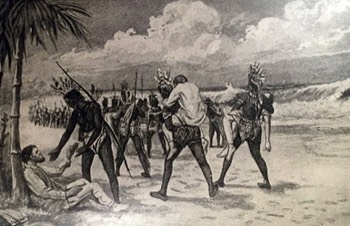
Finally Cabeza's boat was cast ashore on an island. The Spaniards named the island Malhado, meaning ill- luck. On the maps of the present day it is known as Galveston Island.
They built a fire and parched the little corn they had on hand. From pools of rain water they slaked their thirst. One of the men climbed to the top of a tree to get a look at the country. He saw that the island was inhabited by Indians. This news gave the Spaniards a great fright. They feared the Indians might be un friendly, and they were in no condition to fight.
In a short while the Indians, all armed with bows and arrows, came down to the shore. They were not large, but the fears of the Spaniards made them look like giants. To gain their friendship, Cabeza gave them beads and bells. In return they gave him an arrow. They also brought fish and roots to the Spaniards and treated them kindly.
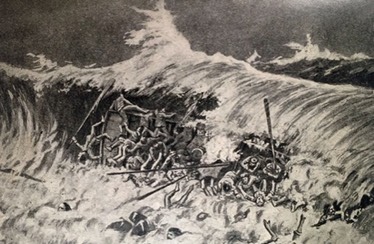
Food and a good night's rest made the Spaniards feel like new men. The next morning they prepared to renew their journey. The boat had settled in the sand of the beach, and was dug out with much difficulty. They got provisions and water from the Indians. Joyfully the men took their places at the oars. The sails were unfurled to the morning breeze, and the little craft moved slowly out upon the water.
The tide was running high. When but a little way from the shore, a great wave passed over the boat, filling her with water, drenching the men and ruining the provisions. She threatened to sink every moment. All hands set to work to bail her out, but the next minute another wave completely upset her. Three of the men, Hooking to save themselves by clinging to the boat, were carried under and drowned. The others, more dead than alive, were thrown violently upon the beach.
They were in a sad plight. That they might work better when digging the boat from the sand, the men had partly stripped themselves of their clothing. This was lost with the boat. The weather was very cold; and with no covering for their bodies they were in danger of freezing. The boat gone, there was no hope of escape by way of the sea. They had no arms to protect themselves, should the Indians prove unfriendly.
The Indians, not knowing of their attempt to escape, returned in the evening, bringing roots and berries. Great was their surprise at finding the white strangers in such a state. Savages as they were, their hearts were touched at the pitiful sight. They made known their sympathy by loud and mournful cries for the space of half an hour. Then taking the Spaniards in their arms, they carried them to the nearest village. Word was sent ahead to build houses for the strangers and to have fires ready for them to warm by. The Indians vied with one another in showing kindness to their guests, who were looked upon as superior beings. There was great rejoicing in the village. There was feasting and dancing the whole night through.
Some days afterwards Cabeza saw a European article in the hands of an Indian. He knew it had not been brought by his party, and he 'asked where it came from. He was told that it was a gift from some other men like the Spaniards, who were not far off. Cabeza was astonished and delighted. He sent a small party at once to seek for these men and bring them to the village. In a short while the party returned with the entire company from one of the other boats, which had been wrecked on a different part of the island. There was great joy over this meeting. There were hand-shakings and embracings, and then embracings and hand-shakings again. And such a talking as there was, as they told one another of their adventures!
The entire party now numbered forty men. They set about at once making plans for escape. They built an other boat, but as soon as it was launched it sank to the bottom of the sea.
There was now no choice but to pass the winter on the island. "Hope springs eternal in the human breast." It sustained the Spaniards in their terrible march through the trackless swamps of Florida; it cheered each little boat as alone and in the darkness it drifted out to sea. When the clouds of misfortune hung thickest, hope was the one star which shone steadily on. When the last boat sank, hope sank with her; but soon it arose fresh and smiling and pointed to the west where the Spanish settlements lay.
It was agreed that four of the strongest men, all powerful swimmers, should swim across the bay and search for the settlements, which were thought to be not far away. From the settlements help could be sent to the wretched party on the island.
"Misfortune travels in a train." "Ills on ills attend." Soon after the four men left, a severe spell of weather set in, which lasted for weeks. Having no coverings for their bodies and little protection from the weather in the rude huts of the Indians, many of the men died from exposure.
The Indians could no longer find roots; their fish nets caught nothing; starvation again set in. A plague broke out on the island, from which half of the Indians died. It carried off all but fifteen of the Spaniards. These were separated and made slaves by the Indians.
In the spring they were taken to the mainland, where Cabeza became very sick. During his illness the others escaped from their masters, and, leaving him to his fate, started westward down the coast.
For six years Cabeza led a slave's life, sometimes on the mainland, sometimes on the island. He lived naked and in all respects like an Indian. At first he was made to do the hardest kind of work. He afterwards said: "I had to get roots from below the water and in the cane where they grew in the ground; and in doing so I had my fingers so worn that did a straw but touch them they bled."
Later on he fared better. He was a clever trader, and his masters allowed him to travel long distances for the purpose of trading. In this way he learned much of the surrounding country, and noted the best path to take whenever he should get a chance to escape.
On one of his visits to the island he found another Spaniard, who, like himself, was sick when his companions escaped. This man's name was Lope de Oviedo. Cabeza made known his plan of escape to Oviedo, and together they started down the coast. After several days' traveling they came upon some Indians, who said that three white men were living with their tribe. These men were all that remained of the first party that escaped. Five of the party had been killed by the Indians and others had died from cold or from ill-treatment. The three remaining ones were treated with the greatest cruelty.
On hearing this Oviedo refused to go farther, and re turned to the island. Cabeza was thus left again entirely alone with this new tribe of savages. Two days later he joined the other three Spaniards, who were much astonished at seeing him. The Indians had told them that he was dead. Cabeza says of their meeting: "We gave many thanks at seeing ourselves together again and this day was to us the happiest that we had ever enjoyed in our lives."
They at once set about planning to escape. But for two years no chance of escape was offered. All this time the Spaniards suffered much from hunger and ill-treatment. Often they had to eat worms, lizards and snakes, and even earth and wood to keep themselves from starving. Three times Cabeza was almost killed by his masters.
"Success waits on him who perseveres." The Spaniards at last got away and took up the search for the settlements in Mexico. For the first few days they traveled with all speed, fearing lest their Indian masters should overtake them.
They soon came to another tribe, where they were treated kindly and where they stayed eight months. While here a very strange thing happened. Fortune smiled upon the Spaniards. From being slaves and the most miserable of men they became masters of the Indians. There was no more ill-treatment now; no more hard work. They were thought to be children of the sun, and everything the Indians had was given up to them.
This is how it came about: The same night of their arrival some Indians came to Castillo, one of the Spaniards, saying they had great pain in the head, and begging to be cured. Castillo made the sign of the cross over them and commended them to God; whereupon they said the pain was gone. Then they went back to their houses, but soon returned with venison for the Spaniards. Many others, hearing of this cure, came to be healed. Each brought a piece of venison, and soon the Spaniards had more meat than they could dispose of.
From tribe to tribe the Spaniards wandered for many days. Wherever they went they were attended by hundreds, even thousands, of the natives. These followers would take neither food nor drink till Cabeza and his companions had breathed upon and blessed it. When a new village was reached, the whole people would turn out to be touched and blessed. At times they pressed upon the Spaniards so closely as to endanger their lives. From far and near the sick were brought to be healed.
At one village the Spaniards desired the natives to conduct them on their journey toward the west. This the Indians refused to do, saying that their enemies lived in that direction. The Spaniards persuaded, but still they objected. At this refusal Cabeza became angry and went to sleep in the woods away from the village.
The next day many of the Indians became ill and some of them died. They thought this trouble had come upon them because of Cabeza's anger. They believed the Spaniards could cause their death by only willing it. They were in great fright lest more of them should die. They begged the Spaniards not to stay angry, and promised to guide them in any direction they wished to go.
Toward the west, and ever toward the west, the Spaniards bent their steps. They came to a range of high mountains, and for days skirted along its base. Then they crossed a great river coming from the north. They passed through a desert, where they almost died of thirst and had nothing to eat but powdered straw.
At last they came to a country where the people were more civilized. Their houses were several stories high mid contained many rooms. Some were built of sun-dried brick and others of cane mats.
At these villages the Spaniards were given buffalo skins for coverings for their bodies. All these years they had gone naked. Cabeza says that not being used to it they cast their skin twice a year like serpents.
It was here, too, that they first saw signs of approach to the settlements, which they had so long been seeking. On the neck of one of the Indians they saw the buckle of ii sword belt, to which was fastened the nail of a horseshoe. Chi being asked where these things came from, the owner mid they came from heaven; that white men with beards like the Spaniards had brought them. They had also brought horses and swords and lances.
Cabeza and his companions were almost overcome with joy at this news. The end of their long journey was in sight. Their trials were nearly over. Freedom and civilization would soon be theirs.
A few days more of travel brought them up with a party of four Spanish horsemen. "They were astonished at the sight of me," says Cabeza, "and so confounded that they neither hailed me nor drew near to make inquiry. I bade them take me to their chief, which they did."
To the captain Cabeza told the story of their marvelous wanderings, and asked them for guides who would lead them to the nearest Spanish settlement.
On April 1, 1536, they reached the town of San Miguel, the first Spanish settlement they had seen in nearly ten years. The governor of the town wept at sight of them, and gave praise to God, who had preserved them from so many dangers.
----------------
By the people of Texas, the name of Cabeza de Vaca should be held in remembrance as that of the first white man who ever passed through her territory.
Look at your map of Texas. From Galveston Island draw a line down the coast to Matagorda Bay; then northwest, following the course of the Colorado River to San Saba; then west to the Pecos River; then to the Rio Grande, near El Paso, and you will have traced out the route of Cabeza.
==========