LA SALLE
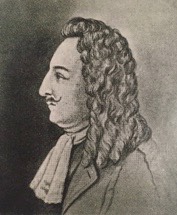
The first white man to make a settlement in Texas was Robert Cavelier de La Salle.
La Salle was a Frenchman. He was born at Rouen, Normandy, in 1643. His father was a rich merchant; and the boy was given all the advantages that great wealth can command. His parents intended him for the priesthood and had him carefully educated for that purpose. He had a great liking for the sciences, and especially for mathematics, in which he made rapid advancement. Up on graduating, his teachers gave him a certificate of good character and of high standing in all his studies.
La Salle was possessed of a strong will, and, when his mind was once made up, nothing could turn him from his purpose. He believed in himself and depended on him- moIf. He was self-controlled and bore without a murmur whatever ills befell him. As a boy he was restless and fearless, and, when he grew to manhood, was always ready for any wild or perilous adventure.
At this time thousands of Frenchmen were flocking to the New World in search of fortunes. Wonderful stories were told of the land beyond the sea. There was the Fountain of Youth, that wonderful spring that would restore youth and beauty to all who bathed in its waters. There was El Dorado, the golden land, where the people ate and drank out of vessels of silver and gold.
The boy, La Salle, heard these stories and longed for the time to come when he, too, might cross the waters and visit the new-found land. He could not study as he once did. The schoolroom seemed a prison to him. Every day he became more restless and discontented. A life of bold adventure was his only dream of happiness. At last he gave up the idea of becoming a priest, and at the age of twenty-four sailed for Canada, where his countrymen had already made settlements.
And now the free life for which he had been longing was his. A continent lay before him, inviting exploration and promising adventures rivaling those of Sinbad the Sailor. The whole of the great northwest was then an entirely unknown land. No one knew how large the continent was — whether one thousand or ten thousand miles across. Some thought that the Pacific Ocean was but a few miles west of the Great Lakes, and that by sail ing up the St. Lawrence River and through the lakes a western route to China might be found — a problem that men had been trying to solve ever since the time of Columbus.
We next hear of La Salle as a fur-trader near Montreal. In the heart of the- forest he built a fort and established a trading post, where for several years he carried on a thriving trade in furs with the Indians. On one occasion he was visited by a band of Iroquois Indians, who spent the winter with him and told him of a great river rising in their country, many leagues to the west, and flowing into the sea. The Indians called this river "Miche Sepe," meaning "Father of Waters."
At this news La Salle's imagination took fire. This was the long-sought route to the Pacific. Already he saw his ships anchored in the ports of China and Japan and loading with the precious stuffs that all the world wanted. Day and night these visions haunted him. He could not rest till he had seen the governor of Canada and obtained his permission to explore the country in search of the great river. The governor was his friend, and readily gave the desired permission; and La Salle set out on his journey to find the great Father of Waters.
Ten long years he kept up his search; up the St. Lawrence; around the Great Lakes, and about the headwaters of the Ohio; through frozen forests and over trackless fields of snow; beset by every form of danger and enduring hardships that would have crushed a less heroic nature. Several times his enemies tried to poison him.
Often he was in danger of starvation and drowning. The Indians were hostile and his friends untrue. Yet through it all his spirit was calm and his temper unruffled. One of his party, Father Membre, writes of him thus: "Though La Salle told to us all his troubles, yet never did I remark in him the least change. He always kept his coolness and self-possession. Any other person would have given up the enterprise. To him dangers and difficulties were but spurs to further effort, and made him more resolute than ever to carry out his discovery."
He had set out to find the Mississippi; and this one thing he would do or die in the attempt. There is no power that can hinder "the firm resolve of a determined soul."
On the 6th of February, 1682, La Salle paddled his canoes out on the broad bosom of the Mississippi. The river was much swollen, and borne on its current were vast masses of ice, floating down from the distant regions of the north. No boat could live in that icy flood, and further progress was impossible. The canoes were dragged ashore and the party encamped upon the banks of the stream to await the disappearance of the ice.
Within a week the navigation was once more free, and the journey was resumed. Near the close of the first day they saw on their right the mouth of a great river. It was quite as large as the Mississippi, and its waters were thick with mud. It was the Missouri, wild and turbulent, rush ing in from the far-away Rocky Mountains and the lonely western plains to share the notice of the great explorer.
Here the party landed and visited an Indian village, where they were kindly received. La Salle was still in tent on finding a passage across the continent to the Pacific Ocean; and from the Indians here he learned strange tidings that greatly excited him. He was told that by ascending the Missouri ten or twelve days he would come to a range of mountains where the river took its rise; and that from the top of these mountains he would have a view of the vast and boundless sea where great ships were sailing.
Wishing to pursue his present course, however, he continued down, the Mississippi. Three days more brought the party to the mouth of the Ohio. Here they encamped and the hunters went out for game. One of them, Peter Prudhomme, wandered off by himself and did not return. It was feared that he had been killed by the Indians. Searching parties were sent out in every direction to look for him, but no trace of him could be found. Giving him up for lost, the voyagers were about to embark when the missing man appeared. He had been lost in the forest, and for nine days had wandered about in a fruitless search for his companions. He was half-dead from exposure and starvation, and the thought of lining left alone in this far-off wilderness had almost crazed him.
Again the explorers embark. Day after day the currant carries them swiftly along. With every turn of the river new scenes of beauty or grandeur open up before them. The cold and snows of the upper stream have been left behind, giving place to the hazy sunlight and warm, drowsy air of the realms of spring. The trees are robed in green, flowers bloom along the banks, and Bong-birds flood the forests with their joyous music.
And now their journey's end is near. The water of the river becomes. brackish and then changes to brine. The current falls to sleep, and is succeeded by a gentle motion like the rocking of a cradle. The banks widen till they almost disappear. The breeze grows fresh with the salt breath of the sea. Farther on and — not the Pacific, but — the great Gulf of Mexico opens on their sight, "tossing its restless billows, lonely as when born of chaos, without a sail, without a sign of life."
The great mystery was solved at last. Returning a short distance up the river, La Salle landed, and with great ceremony took possession of the country for his king,
Louis XIV of France. A massive column was raised, on the shore of the river, bearing the arms of France and inscribed with the words:
"Louis the Great Reigns; April 9, 1682."
Then La Salle, bareheaded, sword in hand, the flag of his country waving above him, proclaimed in a loud voice:
"In the name of the most high and mighty * * * Prince, Louis, the Great, by the, grace of God, King of France, * * * Fourteenth of that name, I this ninth day of April, one thousand six hundred and eighty-two, * * * do now take possession of this country of Louisiana, the seas, bays, harbors, ports, adjacent straits, and all the nations, peoples, provinces, cities, towns, streams, * * * from the sources of the great river Colbert (Mississippi) as far as its mouth at the sea or the Gulf of Mexico."
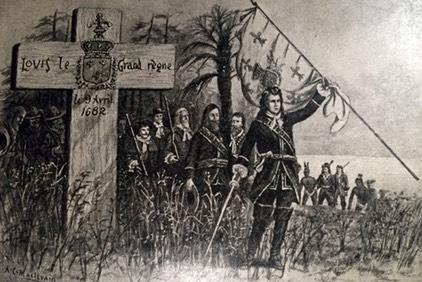
These words were followed by prolonged shouts of "Long live the king" and a discharge of firearms.. Beside the column was buried a leaden plate bearing the inscription, "Louis the Great reigns," and the names of all the Frenchmen of the party. This grand and imposing ceremony was concluded by another shout of "Long live the king" and another volley of musketry, followed by hymns of thanksgiving and praise.
La Salle was a man of action. His greatest happiness was in achievement. Scarcely had the echoes of the hymns died away in the forest when there was born in his
restless brain another mighty enterprise. This was a fair land, fitted to become the home of a great people. Here he would found a new and greater France. He would become its ruler, perhaps its king. With this thought in his mind he resolved to return to Canada, and from thence to France to lay his plans before King Louis, and get permission to make a settlement near the mouth of the Mississippi.
The canoes were headed up stream and urged forward with all speed against the muddy current. There was no game to be taken in the vast swamps near the mouth of the river, and the party was almost famished. For several days there was little to eat except wild potatoes and the flesh of alligators.
And now La Salle was struck down by a foe more subtle than any he had yet met — malaria. For more than a month the burning fever raged. La Salle's bed was a mat in the bottom of a canoe, where he had scarcely room enough to turn over. Sun and rain beat down upon him. He had no physician, no medicine, no nursing. Daily he looked death in the face, but his iron will and strong constitution at last conquered. The sickness left him, but "so weak," he said, "that I could think of nothing for four months after."
At length he reached Canada and sailed for France, landing at Rochelle1 on the 13th of December, 1683. He told the king of the mighty river he had discovered and of the beautiful country through which it flowed. He told of the great fortunes that might be made there trading with the Indians, and of the rich silver mines of Mexico that might be taken from the Spaniards. He told of the poor heathen Indians who might be made Christians, and in glowing words pictured the glory and honor and power that would come to France from the possession of this vast empire.
These plans found favor in the eyes of the king, who, promised every assistance in the undertaking. La Salle was made governor of all the lands he might discover, and four ships were placed at his disposal to make the voyage direct from France to the mouth of the Mississippi.
The principal vessel was the Joli, a man-of-war armed with thirty-six guns. The second was a frigate, the Belle, a present from the king to La Salle, which carried six guns. The other two, the Aimable, and the St. Francis, were merchant ships, loaded with supplies for the settlers and goods to trade to the Indians. About two hundred and eighty persons embarked, including .one hundred soldiers, seven priests, and seven or eight families of women and children.
From Rochelle, La Salle wrote a parting letter to his mother at Rouen:
Madame, My Most Honored Mother:
At last, after having waited a long time for a favorable wind, and having had a great many difficulties to overcome, we are setting sail. • • • • Everybody is well, including little Colin and my nephew. We all have good hope of a happy success. We are not going by way of Canada, but by the Gulf of Mexico. * * * * I hope to embrace you a year hence with all the pleasure that the most grateful of children can feel in being with so good a mother as you have always been, * * * * and be sure that you will always find me with a heart full of the feelings which are due to you. Madame, My Most Honored Mother, from your most humble and most obedient servant and son,
De La Salle.
The four ships sailed from the harbor of Rochelle on the 24th day of July, 1684. La Salle was on board the Joli. When four days out a violent tempest overtook them. The Joli broke her bowsprit and had to sail back to get it mended. When the repairs had been made the fleet again set sail on the 1st of August.
This beginning augured ill of the enterprise; and a wretched voyage" it proved to be. A quarrel arose between La Salle and his chief captain, Beaujeu, commander of the Joli, which grew in bitterness as the days went by. At one time the fleet was becalmed, and for days and days the ships floated as upon a sea of glass.
Down dropt the breeze, the sails dropt down,
'Twas sad as sad could be;
And we did speak only to break
The silence of the sea.
Day after day, day after day,
We stuck, nor breath nor motion,
As idle as a painted ship
Upon a painted ocean.
The calm was succeeded by a storm of great violence, which separated the. vessels, and the store-ship, St. Francis, was run down and captured by a Spanish man-of-war. A grievous sickness, caused by the change of climate and crowded condition of the vessel, broke out on board the Joli. Fifty men, including La Salle and the two surgeons, were in the hospital. La Salle lost his reason for a time, and well-nigh his life.
After sailing for two months the little fleet entered the Gulf of Mexico. All eyes now. kept a sharp lookout for the mouth of the Mississippi. Day after day passed by, but no signs of the great river were to be seen. At last a wide opening was seen between two low points of land, and the sea around was discolored with mud. La Salle thought this was the Mississippi, but he was mistaken; it was Galveston Bay.
La Salle had left one of his vessels behind, and he waited here five or six days for it to come up. He then sailed westward along the Texas coast and tried to land at several places, but the sand bars and breakers kept him back. At one place some Indians swam out through the surf and were taken on board. La Salle was glad to receive them, as he hoped to learn from them something of his whereabouts; but their language was unknown to him and he could not understand their signs.
Still keeping to the west, he saw immense treeless prairies, on which grazed great herds of deer, buffaloes and wild horses. He had seen no such country as this when he sailed down the Mississippi, and he began to fear that he was lost. This fear was well founded; he had made a mistake in his reckoning, and was now nearly five hundred miles west of the mouth of the Mississippi, near the Texas coast where it turns sharply to the south. Being convinced of his error, La Salle ordered the ships put about, and slowly coasted eastward.
They had gone but a short distance when they came to an inlet which a fog had prevented them from seeing before, and which proved to be Matagorda Bay. La Salle thought this was the western mouth of the Mississippi, and landed his men. He carefully staked out a channel for the entrance of the vessels and ordered them to enter at the next high tide. On the 16th day of February, 1685, the Belle made the passage in safety and anchored inside the bay.
A few days later the Aimable, in attempting to follow, was run aground by her captain, who hated La Salle and refused to obey his orders. La Salle was on the shore watching her, and his heart sank within him as he saw her go upon the shoals. The Aimable contained all the ammunition, the tools, and provisions of the colony. Her loss meant ruin to La Salle and the great enterprise he had planned. It was a hard blow, but the great leader received it without wincing. He immediately set to work to float the vessel, but she would not budge an inch. Then with his own boats and some taken from the Indians, he began to remove the stores. He would save them at all events. A quantity of gunpowder and flour was safely landed. Then night came on, a storm arose, and the vessel was dashed-to pieces. Morning showed the bay covered with barrels, chests and bales, and pieces of the broken wreck.
The whole party were now encamped on the sands near the wreck of the Aimable. They were in a woeful plight. They had no water to drink except that taken from the bay, which was brackish and unwholesome, and their food was a porridge made of flour boiled with this brackish water. The bad food and water brought on a sickness, of which five or six died every day.
In this helpless condition the camp was plundered by Indians, who carried away blankets and many other articles of value. The blankets could ill be spared, as the people had lost most of their clothing in the wreck, and were now suffering from cold and exposure.
La Salle sent his nephew, Moranget, with a party of men to recover the stolen property. They went up the bay in a boat, and, coming to an Indian village, marched into it sword in hand. The Indians fled to the woods; and Moranget, seizing what blankets he could find and several canoes belonging to the Indians, commenced his return to the camp.
The party had not gone far before night overtook them, and it became necessary to land and wait for morning. They built a fire, stationed a sentinel, and, wrapping themselves hi blankets, lay down on the dry grass to sleep, The sentinel soon followed their example, when all at once the forest resounded with dreadful war whoops, and a shower of arrows fell among the sleepers. Two of them were instantly killed; a third was severely wounded, and Moranget received an arrow through the arm, and an other cut a deep gash in his bosom. Faint and bleeding, he succeeded in reaching the camp of his friends and told the terrible news. La Salle immediately sent an armed party to punish the Indians, knowing full well that unless he did so more trouble might be expected.
Beaujeu, captain of the Joli, who all along had been angry with La Salle, now refused to obey his orders, and insisted on returning to France. He took with him sixty or seventy of the company,"all of the cannon balls, and many of the stores belonging to the colony. La Salle and his party were left alone in the wilderness; a single small vessel, the Belle, lying at anchor in the bay, offering the only means of retreat or of further exploration.
Soon after Beaujeu's departure, La Salle with five boats and a well-armed party of about fifty men set out to explore the surrounding country. He sailed up the bay to' its head, where he found a river flowing in from the north. Taking it to be one of the mouths of the Mississippi, he ascended it many miles. He found everything different from what he had expected. Instead of widening out into the great Father of Waters, the river narrowed rapidly; its waters were clear, while the Mississippi was thick with mud; instead of the low-lying shores of the Mississippi, covered with a tangled tropical forest, here were broad prairies on which vast herds of buffaloes were feeding. La Salle could no longer doubt; that this was not the Mississippi he was now sure, and he called it Lavaca, or Cow River, from the buffalo cows which he saw grazing on the banks.
This discovery was a great disappointment to La Salle, but it did not abate one whit his determination to find the Mississippi. He knew no such word as fail. He selected a beautiful spot on the bank of the river, where, for the time being, he resolved to settle his people. When they were comfortably provided for, he would resume his explorations. With this plan in mind he returned to the encampment on the bay.
Here he found everything in confusion. Discontent and discouragement had taken hold of the people, and they were loud in their censure of La Salle for having brought them here to die in the wilderness. They had quarreled among themselves, and a plot was discovered to kill Joutel, whom La Salle had left in command of the camp. They were in constant fear of the savages, who often came around the encampment at night barking like dogs and howling like wolves. They had still another cause for alarm. The Spaniards had threatened death to all white men who should come upon these shores; and once they saw a sail which they took to be a Spanish warship coming to destroy them, but it happily passed by without seeing the encampment. One of the chief men of the company was bitten by a rattlesnake and died in dreadful agony. Another, while fishing, was swept away by the current and drowned. Two men deserted to live among the Indians. Others tried to escape, but were caught and punished.
La Salle at once ordered the removal of the women and children, the stores, and most of the men to the Lavaca, where he began the erection of a fort. This was a most difficult undertaking. There was no wood within miles of the place, and no horses or oxen to drag it. While some of the men cut and squared the timber in the forest, others, harnessed like horses, dragged it over the prairie. The weather was hot, and the men, unused to this kind of work, soon gave out. The carpenters were found to be ignorant of their trade, and La Salle himself had to draw the plans and direct the whole work. Food became scarce, sickness again broke out, and in a few weeks more than thirty of the colonists died. Despondency and gloom spread over the whole encampment—La Salle himself almost lost hope.
The work went on, however, in spite of all discouragements, and at length one large building was finished. It was roofed with boards and buffalo hides, and divided into rooms for lodging and other uses. A cellar was dug beneath the building, and in the cellar the ammunition and other valuables were stored as a protection against fire. Loopholes were left in the walls to ward off attacks of Indians, and at the four corners cannon were mounted, which, for lack of cannon balls, were loaded with bags of bullets. A small chapel was built near by, and the whole was fenced with a palisade. To this little fortress La Salle gave his favorite name, Fort St. Louis.
This work off his hands, La Salle was free to renew his search for the lost river. On the last day of October, 1685, with a party of fifty men, he set out on his great journey of exploration. For weeks and months they wandered through the wilderness toward the rising sun; but no glimpse of the river gladdened their eyes or lightened their hearts. Dangers beset them at every turn. "They were obliged to swim swollen rivers; they traversed dangerous swamps and unknown forests; they fought with hostile Indians; they suffered the pangs of hunger and thirst; they were shaken with chills and parched with fever." At last, foot-sore and weary, without hats, clothed in rags, and shrunken to mere skeletons, what was left of the party returned to the fort.
Here indeed things were in a bad way. The last remaining vessel, the Belle, had been wrecked in the bay and was a total loss. Food was becoming scarce, and the ammunition was almost exhausted. The Indians were hostile and were daily becoming more bold in their attacks upon the fort. Deaths from sickness and other causes
had reduced the number of the colonists to less than forty; and these had completely lost heart. These multiplied misfortunes bore heavily upon La Salle. Until the loss of the Belle he had thought, if the worst came to the worst, that the remnant of his little company might find their way back to France. This hope was now gone. He fell dangerously ill, and for many days his death was expected.
He got well, however, and at once began to make ready for another journey. This time he took twenty men. with him, among whom were his brother, Cavelier, and his nephew, Moranget. They journeyed in a north easterly direction over plains gay with flowers and green as emerald, and alive with countless herds of buffaloes. The animals were so tame that the hunters had no difficulty in killing nine or ten of them.
One day, when crossing a beautiful-prairie, La Salle's Indian servant, Nika, suddenly cried out, "I am dead! I am dead!" A rattlesnake had bitten him on the leg, which instantly began to swell and throb with pain. With their pocket-knives they cut out the flesh around the wound and made deep gashes near it, hoping that the free flowing of the blood would carry away the poison. They then applied poultices of herbs which they knew to be useful in such cases, and which soon, reduced the swelling and relieved the pain.
At length they came to a broad river, which La Salle and a few others tried to cross on a raft. As soon as they pushed out from the shore, the rapid current seized the raft, and, after whirling it round and round, swept it down the stream, where it disappeared. The men on the bank were in great distress. They knew not what to do. All that day was spent in tears and weeping. Just before nightfall, when they had given La Salle up for lost, they saw him and his party advancing along the opposite bank. Several miles down the river the raft had struck a tree, which had been torn from the bank and had lodged in the middle of the stream. Seizing the branches of this tree, the men dragged the raft out of the current; it-was then an easy matter to guide it to the shore. Both parties spent the night in great anxiety.
In the morning another raft was made, on which five men, all trembling with fear, safely crossed and rejoined La Salle. Two of the most timid ones were left behind. They dared not venture the passage; but, seeing La Salle getting ready to march without them, they shouted across the river, begging not to be left. Their fear of being abandoned was greater than their fear of the river, and they quickly built a raft and crossed over to their companions.
Journeying on they soon came to the villages of the Cenis Indians, on the Trinity River. They were received by the Indians in the most friendly manner. The chief, bearing the peace-pipe, came out to meet them, and by signs made them understand that they were welcome. "Then the whole village swarmed out like bees, gathering around the visitors with offerings of food and everything that was precious in their eyes." La Salle was lodged with the great chief and shown every attention. His men were entertained with feasting and dancing.
Horses were abundant among these tribes, and La Salle purchased several for the use of his party. A horse was readily given in exchange for an ax.
After a delightful visit of three days among these hospitable people, the explorers continued on their journey. They had gone but a short distance when four of the men deserted and went back to live with the Indians. Then La Salle and his nephew, Moranget, were both at tacked by fever, which caused a delay of nearly two months; and when they had recovered sufficiently to travel, it was thought best to return to Fort St. Louis. Their party was much reduced by desertion and death, their stock of ammunition was running low, they were five hundred miles from Fort St. Louis, and the Mississippi seemed as far away as ever.
They were greatly aided on their return by the horses bought from the Cenis, and they suffered no serious accident except at the crossing of the Colorado River. La Salle and two of his men were making the passage on a light raft of canes. Suddenly an enormous alligator raised its head above the water, and, quicker than thought, seized one of the men in its horrid jaws and drew him under. One short, loud shriek broke from the unfortunate man as the waters closed over him. For a moment the waves were discolored with his blood, a tiny whirlpool danced above his watery grave, and the great river flowed placidly on, giving no hint of the dark tragedy hidden in its bosom.
On the 17th of October, 1686, the wayworn and sadly diminished party, after an absence of six months, re-entered the gates of Fort St. Louis. Of the twenty who went forth only eight returned. The last ray of hope had departed from the fort, and a sullen despair had taken possession of the inmates. It was in vain that La Salle spoke words of encouragement and cheer; in vain he tried to persuade them that all was not lost, and that he would yet find a way to save them. His appeals fell on deaf ears; they would not be comforted.
The question of finding the Mississippi now gave place in La Salle's mind to the more pressing one of saving the lives of his people. Aid could be had from Canada, and he resolved on a journey thither, though two thousand miles of wilderness lay between.
Two months were spent in strengthening the fort and laying in a store of provisions for those who were to be left behind. Then all in the fort fell to work preparing an outfit for the travelers. There was such a dearth of clothing that the sails of the Belle were cut up to make coats for the men.
At last everything was ready. The horses stood in the open square of the fort packed for the march, and the little company, those who were to go and those who were to stay, gathered together for the final leave-takings. La Salle, in his faded red uniform, called them closely about him and made them a last address so full of feeling that all were moved to tears. Twenty men, just half of the remnant of the colony, were chosen to go on the expedition. Among them were La Salle's two nephews and his brother, Cavelier; Nika, La Salle's Indian servant; the trusty soldier, Joutel; a priest, Father Anastase Douay; Liotot, the surgeon, and Duhaut. These, armed and equipped for the journey, are drawn up in front of the gate; the last farewells are taken, and the little band of adventurers, "with measured tread and slow," file out of the enclosure. They cross the river and the prairies beyond; then woods and hills come between and shut Fort St. Louis forever from their sight.
The journey was begun on the 12th of January, 1687, in a northeasterly direction. "They passed the prairie and neared the forest. Here they saw buffaloes, and the hunters killed several of them. Then they traversed the woods, found and forded the shallow and rushy stream, and pushed through the forest beyond, till they again reached the open prairies. Heavy clouds gathered over them, and it rained all night, but they sheltered them selves under the fresh hides of buffaloes they had killed. They suffered greatly from want of shoes, and for a time had nothing better to cover their feet than rude casings of raw buffalo hide, which they were forced to keep always wet, as when dry it hardened about the foot like iron. At length they bought dressed deerskins from the Indians, of which they made tolerable moccasins.
"The rivers, streams, and gulleys filled with water were without number, and to cross them they made a boat of bull-hide, which they carried with them, strapped, on the horses' backs. Two or three men could cross in it at once, and the horses swam after them. Sometimes they traversed the sunny prairie; sometimes dived into the dark recesses of the forest, where the buffaloes, coming daily from their pastures in long files to drink at the river, made a broad and easy path for the travelers. When foul weather arrested them, they built huts of bark and long meadow grass, and, safely sheltered, lounged away the day, while their horses, picketed near by, stood steaming in the rain. At night they usually set a rude stockade about their camp; and here, by the grassy border of a brook or at the edge of a grove where a spring bubbled up through the sands, they lay. asleep around the embers of their fire, while the man on guard listened to the deep breathing of the slumbering horses and the howling of the wolves that saluted the rising moon as it flooded the waste of prairie with its pale, mystic light."
It was the middle of March, and the party had proceeded as far as the Neches River, in what is now east Texas, when a quarrel among the men, which had been brewing all along, broke out into open violence. Duhaut and Liotot, the surgeon, hated La Salle and his nephew, Moranget, and had sworn vengeance against them. Duhaut, being a man of property in France, and having lost everything by this expedition, charged La Salle with being the cause of his ruin; Liotot charged him with having caused the death of his brother. On one of the former journeys this young man's strength had. failed and La Salle ordered him to return to the fo$t. On the way back he was attacked and killed by the Indians.
The party encamped near a spot where La Salle on his preceding journey had cached — that is to say, hidden in the ground or a hollowed tree a quantity, of beans and Indian corn. As provisions were getting scarce in the camp, La Salle sent a party to find this hoard. These men were Duhaut, Liotot, Nika and Saget, La Salle's two servants, and three others. The food, when found, was spoiled; but as they were on their way back to camp they saw buffaloes, and Nika killed two of them. They cut up the meat and laid it on scaffolds for smoking, and sent word to La Salle to send his horses for it.
Next morning a party of five, led by Moranget, with the necessary horses, was sent to bring in the meat. When they arrived at the hunters' camp, they found the men who were cutting up the meat for drying also cooking some of the choicest portions for themselves. At- the sight of this Moranget, who was of a hot and testy temper, began to scold and threaten Duhaut and his party, and ended by seizing all the meat, including that which had been cooked. A t this uncalled for conduct, Duhaut's old grudge blazed out anew, and he drew off his men a short distance to take counsel together how they should kill Moranget.
"Night came; the woods grew dark; the evening meal was finished, and the evening pipes were smoked." Huge fires were built, the guard was stationed, and, wrapping their blankets around them, all lay down to sleep. It was arranged that Moranget, Nika, and Saget, all of whom were to be killed, should keep the earlier watches of the night.
Each of them has taken his turn, and now Duhaut is called. At signal from him, his followers, who have only been shamming sleep, rise cautiously and make ready for the desperate deed. The fires have burned low. The deep and regular breathing of the victims shows that they are in profound sleep. No evil is suspected. All goes well. Duhaut and one other stand with guns cocked, ready to shoot down anyone who resists or attempts to fly. Liotot, with an ax in his hand, creeps stealthily toward the sleepers and strikes a rapid blow at each. Nika and Saget are killed instantly. Moranget's skull is split from crown to chin, but he starts up as if he would resist his slayers, and is dispatched by a second blow.
One crime always leads to another. Scarcely were the bodies of Moranget and his companions cold in death than a new crime was meditated. La Salle would inquire for his friends; he would learn of their death, and would take a terrible vengeance on their slayers. And so, taking counsel of their fears, the murderers resolved that La Salle, too, must die.
La Salle at his camp six miles away awaited with impatience the return of Moranget and his party. He knew not why, but he felt that something had gone wrong with them. When, after three days, they did not appear, he resolved to go and look for them. Not knowing the way, he gave an Indian a hatchet to guide him. Then leaving Joutel in charge of the camp, with Father Anastase and the Indian guide, he set out in search of the lost ones.
"He was so troubled," writes Father Anastase, "that he no longer seemed like himself. All the way he talked to me of piety and grace, * * * and of the debt he owed to God, who had saved him from so many perils during more than twenty years of travel in America."
At length they came in sight of Duhaut's camp, which was on the farther side of a small river. La Salle fired his gun as a signal of his whereabouts to any of his men who might be within hearing. Duhaut heard the shot, and guessing rightly by whom it was fired, he and Liotot, with guns cocked, crouched down in the long, dry, reed-like grass and waited for La Salle to come up. When within speaking distance, La Salle, seeing some one on the river bank, asked where was Moranget. The man answered something that could not be understood and pointed to the spot where the two murderers were hidden. At the same moment a shot was fired from the grass, quickly followed by another, and, pierced through the brain, La Salle dropped dead (March 19,1687).
"The poor, dead body," writes Joutel, "was treated with every indignity." With barbarous cruelty they stripped it naked, dragging it into the bushes and left it a prey to the buzzards and the wolves."
Few names in the history of our country are entitled to stand so high on the roll of fame as his whose story has just been told. La Salle stands forth to the world as the hero of a fixed idea and a determined purpose. His purpose was more to him than life itself, and in its pursuit he dared every danger and endured every hardship. Like a rock that braves the tempest, he withstood "the rage of man and the elements, the southern sun, the northern blast, fatigue, famine and disease, delay, disappointment and deferred hope," and died at last with his will unshaken and his purpose firm. He died with his great work unfinished, his purpose unfulfilled, which has caused some to say that his life was a failure; but to this no Texan can subscribe, for Texas is La Salle's dream realized.
==========