DRAWING THE BLACK BEANS
Scarcely two months after the fall of the Alamo, Santa Anna was a prisoner in the hands of General Houston. The last Mexican had been driven from Texas soil, and Texas was free.
Peace, like the gentle dew from heaven, settled down upon the country. No longer was heard the tramp of marching men; no longer the sound of hurrying feet, flying from a foe that knew no mercy; no longer the angry cannon's roar boomed over the prairies; no longer the battle shout affrighted peaceful vales. Once more deserted homes were filled with life and light. Once more the plough and sickle brought abundant harvests. Happiness returned to the hearts of the people. But their troubles were not yet over.
On his promise not to fight against Texas any more, Santa Anna was set free. In a few years he became emperor of Mexico. He now forgot his promise and sent an army of twelve hundred men under General Woll to take San Antonio.
Early one Sunday morning in 1842 the people were startled from their beds by the roar of cannon. They scarcely had time to dress when they were surrounded by Mexican soldiers and told that they were prisoners.
The news soon spread all over the country, and men came flocking toward San Antonio to drive out the invader. They assembled under the walls of the old Mission Conception, about two miles from San Antonio. Here General Somervell took command and marched against the city. When the Texans arrived there they found that Woll had retreated and taken many prisoners with him. Brothers, sons, fathers, countrymen were prisoners, and they must be set free. Santa Anna must be taught to keep his soldiers at home and to let the Texans alone.
With these thoughts in their breasts, the Texans took up the line of march for the enemy's country. The wintry winds from the bleak prairies howled about their ears. Many of the men were thinly clad and suffered much from the cold. Recent rains had turned the prairies into an ocean of mud through which they toiled with much difficulty.
At last they reached the banks of the Rio Grande, where the city of Laredo now stands. Beyond was the land of the cruel Santa Anna. The men asked to be led across the river at once into the enemy's country. General Somervell refused and ordered the men to return to their homes.
Without fighting! Without striking one blow for their country's honor! Without making one effort to release the unhappy prisoners! Was it for this they suffered on their long, wearisome march? It should not be so.
Three hundred of them refused to go home. They. chose Colonel William S. Fisher as their leader and marched down the Rio Grande till they came to the Mexican town of Mier. Here they found the Mexican general, Ampudia, ready to receive them.
Though he had ten men to their one, the Texans made up their minds to fight him. Here was their chance. Now they would teach Santa Anna his lesson; they would show him what it meant to interfere with the rights of Texans.
The night before Christmas Colonel Fisher decided to attack the town. The night was pitch dark and a drizzling rain was falling. The men were wet to the skin and it was all they could do to keep their powder dry. Most of the night was spent in trying to find a place to cross the river. There were two fords not far away, but they were closely guarded by the enemy.
At last a crossing was found, and the little army took up its march. Silently, one by one, they clambered down the steep bank and waded through the dark waters. They had scarcely reached the other side when they were set upon by a body of Mexicans. "Let them have it, boys," shouted the commander; and a hundred rifle balls went whizzing into the enemy's ranks.
The Mexicans turned and fled, but soon came back with more men and the fight began in good earnest. The Texans pressed forward to the city, fighting every foot of the way. The Mexicans had planted cannon in the street and kept up a raking fire. But no harm was done to the Texans. They escaped by dodging around the corners. When the cannon balls had passed, they would jump into the street and shoot down the gunners.
On one side of the street, close to the Mexican cannon, was a row of strong stone houses. Into these houses the Texans rushed, first battering down the doors. With crow bars and axes, they made holes in the walls, through which they poured a deadly fire upon the enemy. Three times the Mexican cannon were silenced, all the gunners having been killed.
The Mexicans now took to the housetops and returned the fire, this time killing and wounding several of the Texans. The firing kept up till noon, when a white flag was seen coming from the Mexican lines. The Texans could scarcely contain themselves for joy. They shouted to one another, "We have won the day, boys, and Ampudia is going to surrender." But their joy was short-lived. All too soon it was turned into grief.
Colonel Fisher went out to meet the flag-bearer, who brought a message from General Ampudia. The message said that it would be useless for the Texans to fight any longer; that General Ampudia already had a large army in the town, and, in a short while, eight hundred fresh troops would arrive; that the Texans should surrender and save further bloodshed; that they would be treated well and exchanged for Mexican prisoners; that if they did not surrender, they would be captured and all of them put to death. Five minutes were allowed in which to return an answer.
Colonel Fisher drew the men up in line and gave them the message. He said that he thought it would be best for them to surrender; that General Ampudia was a man of his word, and could be trusted; that in a little while all would be exchanged and on their way back to their homes.
The men listened in silence till he had finished, when a cry of surprise and anger burst from every lip. No; they never would surrender! While there was one load of powder and ball left and a man to fire it, they would fight. They had not yet forgotten the Alamo and Goliad, and, thinking of them, they could never trust the word of any Mexican.
After the first excitement was over, a few of the more faint-hearted marched into the Mexican lines and laid down their arms. In a little while others followed, and still others. Soon all, with bowed heads and aching hearts, stood before the Mexican general — prisoners!
General Ampudia had promised that they should be kept close to the Texas border till they were exchanged. But he did not keep his promise. For five days after the battle he kept them shut up in close rooms, where they were almost stifled with bad air. Then he took them out, put heavy irons on their hands, tied them together in pairs, and set out for the City of Mexico, a thousand miles away. To the right and left of them and behind them marched Mexican soldiers with fixed bayonets.
The men had not walked for some time, and suffered much from sore feet. They were not allowed to stop for water, and they almost died of thirst. At night they were herded in filthy cow pens. Cold north winds blew upon them, chilling them to the very bones. Their blankets had been stolen by the Mexican soldiers and they had scant fires. When the fires burned down, they would rake away the burned coals and lay themselves in the warm ashes. When a town was reached, they were marched through the streets and around the square like the animals on circus day.
For six long weeks this terrible march was kept up. But the Texans did not lose heart. When suffering most, they were cheerful and uncomplaining. Their minds were kept busy with plans for escape, and they had no time to mope and fret.
On February 10, 1843, they reached the farmhouse of Salado. Here they determined to make a strike for freedom. Next morning at sunrise they rushed upon their guards, who were eating, breakfast, and took away their guns. Then out into the yard they went. Here were one hundred and fifty soldiers. These they scattered right and left, took their weapons and horses, and with all speed set out for home.
They were free once more, but surrounded by many dangers. They were in a strange country hundreds of miles from home. Their guides had been killed at the farmhouse. The Mexican soldiers would be sure to follow them.
To keep the Mexicans from finding them, they left the main road and took to the mountains. Here they lost themselves and wandered about for days and days without food and water. Their tongues became so swollen that they could not close their mouths. Some of them became crazed.
They killed their horses for food, but this only lasted a short while. They now had to travel on foot. But they were too weak to walk far; every few minutes they would have to sit down to rest. They threw away their guns, as they were not strong enough to carry them. While in this condition they were surrounded one night by a band of Mexican soldiers and all taken prisoners again.
The leader of this band was General Mexia. He was a brave, kind-hearted soldier, and treated his prisoners well. He gave them food and water and carefully tended the sick. When they were strong enough, he took them back to Salado.
With sinking hearts they returned to their prison. What now would become of them, no one could guess. They knew Santa Anna too well to believe that he would forgive them for trying to escape. Whatever might be their fate they determined to meet it like men and Texans.
In a few days orders came from Santa Anna that all should be shot. General Mexia and other good men wrote to Santa Anna and begged him to spare the prisoners. He would not spare all, but was willing to have only one man out of every ten shot. General Mexia thought this was not right, either, and refused to obey the order. But Santa Anna was determined that they should die. Another officer was sent with orders to shoot every tenth man.
The prisoners were heavily ironed and drawn up in line in front of their guards. The cruel orders were then read to them by one of their number. When the reading was finished, an officer, holding an earthen mug in his hand, came into the shed where they were confined. In the mug were one hundred and seventy-six beans, the number of the prisoners. One hundred and fifty-nine beans were white and seventeen were black. The prisoners were each to draw a bean from the mug. The black beans meant death.
As their names were called, each man. stepped forward and drew. Not a step halted, not a hand shook. The men had faced death too often to be afraid of it now. Besides, how sweet it is to die for one's country!
Major Cocke drew a black bean. Holding it between his thumb and forefinger, he said, "Boys, I told you so; I never failed in my life to draw a prize."
Major Robert Dunham said, "I am prepared to die and would to God I had the chance to do the same thing over again."
James Torrey, almost a boy, said, "For the glory of my country I have fought, and for her glory I am willing to die."
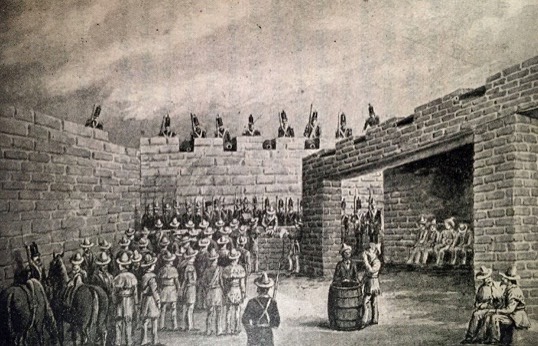
When all had drawn, those having black beans were marched outside the shed and had their irons knocked off. They were then told to prepare for death. All knelt down, and Major Dunham offered up a feeling prayer. Some of their comrades who had drawn white beans were allowed to go out and take leave of them. They sent many loving messages to the dear ones in the far away Texas homes.
The victims wished to die like brave soldiers with their faces to the foe, and asked to be shot in front. But this was not allowed. They were tied together, blindfolded, and made to sit down on a log with their backs to the soldiers. Just about dark the word was given — "Fire!" — and half a hundred musket balls went speeding on the errand of death. Again and again the guns rang out on the evening air, and then all was still. The terrible deed was done.
Santa Anna's cruelty had claimed seventeen more victims; to freedom's honor roll seventeen more heroes were added. A trench was hastily dug and seventeen lifeless bodies, without shroud or coffin, were thrown into it. Here slept the brave men of Mier for years. But they were not forgotten. In 1848 their bones were dug up by tender and loving hands and brought back to Texas. They were reburied at La Grange, where a beautiful monument, erected by the State of Texas, marks their last resting-place.
==========