CASTLE PEROTÉ
The drawing of the black beans took place on March 25, 1843. The morning after the fatal lottery the remaining prisoners, tied in pairs and strongly guarded, again took up the march for the City of Mexico.
Being unused to mountain travel, the prisoners soon broke down. When they were ready to drop helplessly upon the ground, the sharp prick of a bayonet in the hands of a guard would send them staggering a few paces farther. At night they were thrown into filthy, foul- smelling, vermin-filled rooms, where they could get no rest. At other times they were herded in stables with horses, cows and other animals.
After many days of toilsome marching the City of Mexico was reached. The prisoners were greatly rejoiced, as they believed that they would soon be released. With a little money, which they happened to have, they bought ice creams and cakes and made merry over their coming good fortune.
As the days passed by and brought no order for their release, the prisoners began to grow uneasy. What if Santa Anna should play them false again? Their fears were heightened by the changed manner of their guard. Some days the prisoners were given nothing at all to eat, and at night they had to sleep on dirty blankets on the open pavement, where they were almost devoured by mosquitoes and other insects.
Early one morning a company of cavalry rode up to their station and an officer gave to the captain of the guard a sealed packet. It was an order from Santa Anna for the prisoners to be taken to the strong castle of Peroté, one hundred and sixty miles away. "In a few minutes," says one of the prisoners, "each of us had to roll up his dirty blanket and sheepskin, take them under his arm, and march down the street with a file of mounted lancers on either side."
In a short while the prisoners were allowed to hire donkeys, which they rode without bridle or saddle. Though a donkey's ears are large, he seems never to hear any commands to go faster, and the only way to get him to move at all is to prick him with a sharp-pointed stick just above his tail.
As the prisoners were traveling through the mountains in this primitive style, they came to the place where General Mexia, the kind-hearted officer who refused to have the Mier men shot, had sacrificed his own life for liberty's sake. He hated the tyrant Santa Anna and longed to have Mexico rid of him. Driven from Mexico by Santa Anna, he came to the United States. At New Orleans he raised a small force of men and, returning to Mexico by sea, attacked the important city of Tampico. He was badly defeated and most of his men were killed or taken prisoners. Twenty-seven of them were afterward shot by order of Santa Anna.
Mexia escaped and returned to New Orleans, where he soon raised another force for the capture of the Mexican capital. When he landed in Mexico, he was met by an army that claimed to be friendly to his plans. The two armies marched together till well up among the mountains, when his supposed friends declared that they were soldiers of Santa Anna and called on him to surrender. Taken thus by surprise and being greatly outnumbered, he could do nothing else than obey. He was then carried before Santa Anna, who offered him his life if he would quit fighting against him. "No, sir,"said the grand old soldier, "I will oppose you as long as I have an arm to strike for liberty." The Mexican president then ordered him to be taken out and shot.
His blood rendered this spot sacred to the Texan prisoners. Here freedom's last champion had fallen; humanity's last friend had here found a grave. They called to mind his kindness to them when, sick and starving, they were recaptured after their flight from Salado. Their hearts were torn with conflicting emotions. Grief, anger, pity, hatred, by turns flashed over them. Oh, for one hour of freedom, with their good rifles in their hands! They would tear down the walls of Santa Anna's palace and wreak vengeance upon him for all his misdeeds. The guards, suspecting their thoughts and fearing an outbreak, hurried them away. Three days later they came in sight of their prison, Castle Peroté.
This castle was a hundred years old and one of the strongest in Mexico. Its walls were sixty feet high and eight feet thick, and built of stone so hard that the toughest steel could scarcely make a dint upon it. Just outside the walls was a great ditch, or moat, two hundred feet wide and twenty feet deep. In times of danger this moat was filled with water and the only means of crossing it was by a drawbridge let down from the castle side. On the farther side of the moat was another stone wall, and fifty feet beyond this, a wooden palisade built of squared cedar timbers, twelve feet long, set upright in the ground. Another and smaller ditch outside the palisade completed the works. Eighty pieces of artillery planted upon the walls commanded every approach to the castle.
Inside the castle proper were storehouses, soldiers' quarters and cells for prisoners, all opening upon a center square, or plaza, which was used as a parade ground by the soldiers.
Amid the blast of bugles and the roll of drums, the Texans were conducted across the drawbridge to the plaza into the presence of the governor of the castle. Here they met, in rags and chains, fifty of their countrymen who had been captured by General Woll in his raid on San Antonio. The names of the newly-arrived prisoners were called to see that none had escaped; then they were numbered and thrown into one of the large dungeon cells of the castle. Next to them, in another large cell, the men from San Antonio were confined.
The floor, ceiling and walls of these cells were of solid stone. Each cell had only one small door, and a loop hole four by twelve inches in size. No ray of sunshine ever entered the cells. The air was cold, thick and stifling; foul odors filled every nook and corner of this dismal prison.
It was with a sort of dazed feeling that the prisoners found themselves in one of these gloomy dungeons. The thick darkness blinded them and for a while they huddled together near the door, utterly confounded. As their eyes, however, grew accustomed to the darkness, their spirits revived and they began to explore their prison. With the palms of their hands, they felt over every foot of the walls as high as they could reach; in like manner, on their knees, they examined the floor. Solid rock everywhere!
Robert Dunham was right when he said that he had drawn a prize in the fatal black bean. Better a thousand deaths than life in this horrible place! Why had not some friendly bullet set them free at Mier? Why had not starvation claimed them in the mountains? The traitor, Mexia! why had he not carried out the orders of his master? How gladly would they go to execution now if Santa Anna would but give the order! With such thoughts as these running through their minds, they sank down on the cold, hard floor and in fitful slumbers and feverish dreams passed their first night in Castle Peroté.
Weak and wan and shaking with ague, brought on by the damps of their dungeon, it was a forlorn little company that was summoned before the governor the next morning. They were lined up on the plaza, where orders were given to put them in irons. Two and two they were fastened together, one by the right foot and the other by the left. With a smile on their lips, but with vengeance in their hearts, the men stepped forward to receive their "jewelry," as they called the chains.
This, kind of jewelry, however, was not becoming to Texans. It might do for the slavish Mexicans, but for free-born Americans, never! The chains were scarcely riveted before plans were made to get them off. Some bribed the blacksmith to use leaden instead of iron rivets. These when blackened with charcoal looked like iron and could be easily taken out. Others broke their chains by pounding them against a large stone with a cannon ball which was found in the cell.
The chains were laid aside except when a visit was expected from the officers of the castle. Whenever they heard an officer coming, every man jumped for his "jewelry" and clamped it on in great haste, putting on at the same time a look of the most perfect innocence. The warden threatened the severest punishment if the chains were not worn; but no sooner was his back turned than the irons would be on the ground again.
Not many days after their arrival at the castle, the prisoners were told that they must go to work. Their first impulse was to refuse. They were prisoners of war, and for this there seemed to be no help; but as for being slaves to these yellow, pepper-eating barbarians — never! they would die first. All protests, however, were useless, and they were set to work with wheelbarrows, cleaning the castle of its filth. After this they were harnessed to wagons, twenty-five in a team, and made to haul rocks from the mountains for the repair of the fortifications.
The labor was severe, but "at no time," says one of the prisoners, "did the men lose their buoyant spirits; nor did they ever lose an opportunity for fun. McFall, a large, powerful man, was put in the lead, and was always ready to get scared and run away with the wagon. This was often done, and the corners of the adobe houses always suffered in such cases. The Mexican officers would laugh and the owners of the houses would swear in bad Spanish. Sometimes the team would stop in the street, throw off the harness, and half of them go into a drinking house on the right, and the other half to another house on the left. When they were driven out of one house they would run over to the other, thus keeping the overseers busy." The overseers, who were usually convicts, carried a lash which they were permitted to use whenever the prisoners became, unruly; but they seldom resorted to it, as the Texans, at the peril of their lives, would return each blow with interest.
One day while Middleton, the prisoner quoted above, was stooping to receive a load of sand which he was to carry on his back to the castle, he was struck by an overseer. Quick as a flash he dropped the sand, and, seizing a stone, knocked the overseer down. The guards ran up, but a Mexican officer present protected the prisoner from the fury of the overseers.
Various devices were employed for escaping work, not that the work itself was overburdensome, but the thought of having to do it for the "Greasers" was what hurt. Dan Henrie said that he never put any stones on the mountains and "he would be shot if he took any away." So saying, with a steel pen which he found on an officer's writing table, he scratched both his legs from knee to ankle and wrapped them in many folds of old shirts and blankets. The next day when the order came to go to work, his legs were so sore and inflamed that he could scarcely walk, and in consequence his first day's work was his last.
It would have been better for the prisoners had they kept cheerfully at work. It would have kept them in the open air, away from the disease-breeding dungeons of the castle, and preserved their health. As it was, they were confined more and more closely as the days went by. At length they were attacked by a virulent fever which soon sent most of them to the hospital. Of the entire number of prisoners only three escaped this dreadful visitation. Eighteen of them died and were buried in the ditch surrounding the castle.
" That disease! How can I find language to describe it?" writes one of the prisoners. "The sufferings of others I could only judge by sight; but mine I knew by experience—I felt them. I lay in the hospital thirty days, fourteen of which I was entirely unconscious. In my delirium I imagined myself many, many miles away from misery and among friends. But, alas! I lay on a sick couch, unattended and uncared for. And, oh! such sickness, such misery! Give me death in any shape save from that disease."
The prisoners lived in the hope of being released. This thought sustained them in their waking hours, and in dreams brought them comfort and consolation. But the days dragged slowly by and lengthened into weeks and months; and their dungeon claimed them still. Every indignity was heaped upon them. They were cursed and abused and beaten. Scarcely enough food was given them to keep soul and body together; and what they did get was horribly cooked and unfit for dogs, much less men. The meat was so rotten that when thrown against the wall it would stick like glue.
To while away the time and keep up their spirits, the prisoners spent several hours each day in dancing and singing. "During a dance," says one, "we step to the music of a violin with the clank of chains as an accompaniment. The clatter of the irons would be dismal to others; but we are well acquainted with it, and what was once so dreadful is now nothing. In singing we are at times so loud and harsh that it causes the guard to quake with fear. 'Rosin the Bow' is sung excellently. We sometimes laugh so loud and long that the officer on guard orders us to 'keep silence.'"
One of the men kept a journal, in which he wrote down the happenings of each day. The above quotation is from this journal, which continues as follows:
"August 1, 1844. —We have been changing rooms today. The governor causes us to move occasionally, so that the guard can look for holes in the floor or walls.
"2d.—The carpenters are all chained two and two and put to work outside the castle.
"3d._ Nothing to eat, as usual.
"6th. — We move again.
"10th. — Nine of us went to the mountains for brooms, but could not slip away for home.
"15th.—This is our mail day. Our only pleasure is in the hope of receiving news from home concerning our friends or our liberation. But we are disappointed this time.
"16th. — This is wash day with me. I wash very well when I have any clothes to operate on, but they are scarce. I have learned today that the men in room No. 7 (I am in No. 8) are trying to dig their way out.
"19th. --- We have come to the conclusion that there is no possible chance for our liberation by peaceable means; and, therefore, if we risk nothing, nothing will we gain. The first half chance I get, I'm off, off!
"23d. — This morning fifteen men went to the mountains, about five miles off, after rock. While loading the cart, two of them, Bush and Thurmond, taking advantage of the slight negligence of the guard, ran off. In the confusion and hurry the guards forgot to fire upon them and they succeeded in getting away. Thurmond was run down and brought back in about two hours. We have not yet heard from Bush.
"Thurmond states that he was fired at by a soldier, who came near him, but the ball passed harmlessly over his head. After running for some time — as long as he could - he fainted and fell. He does not know how long he thus remained senseless. On coming to, he arose and, scarcely able to walk, managed to pull himself along by some bushes into the bed of a ravine. While thus working his way along, he was overtaken by two mountain Indians. He kept these at bay with a pocket knife till at length, casting his eye up the mountain, he saw advancing on him a squad of Mexican soldiers. Escape was impossible, and with what grace he could he gave himself up and is now lying in a dark, damp cell, alone, double-ironed and very sick.
"The major of this post now says that we shall not receive any more money from our friends, nor cook any more food in our own way; in short, that we shall live, as do the criminals, on weak coffee in the morning, poor meat and broth at noon, and boiled beans at night. He is greatly enraged. Let him look out for squalls."
About a year previous to this record, in July, 1843, sixteen prisoners, under the leadership of General Thomas J. Green, succeeded in escaping by boring through the castle wall. The only tools they had to work with were some narrow carpenter's chisels of very poor quality, which they had smuggled in under their blankets. The officers were always on the lookout for attempts to escape and, as will be remembered, made the prisoners change rooms often so that the floors and walls might be inspected; consequently the greatest caution was necessary to avoid discovery.
Nothing daunted by these difficulties, and inspired by the hope of freedom, the slow work was begun. The labor of hours was necessary to loosen one tiny chip; and as the product of a hard day's work not more than a hatful of chips could be gathered. But there was joy over that small hatful. Only one man could work at a time; and he only by lying prone and resting on his elbows, which position soon became very painful. After working his turn, he would gather up the bits of stone and mortar he had broken off and bury them under some loose brick in the floor, and another would take his place.
Under the incessant labor of the prisoners, the breach in the wall grows deeper and deeper; and at last the stone gives back a hollow sound, which denotes that the end is near. At that sound the tool drops from the nerveless hand of the laborer; his elbows give way and his face falls on the stone; he shakes as with an ague and sobs like a child.
The work was continued until but a thin shell remained on the outside, which could easily be broken through when the time came for leaving. In the meantime preparations for flight were made. Little by little, sugar, bacon and chocolate, enough for two weeks' rations, were bought with money provided by a friend in Mexico. Bread furnished by the prison was saved and stored away. Each man was supplied with a heavy walking cane of sapote wood, which had been made by the carpenters at odd times and secreted. These canes, together with pocket knives, were their only weapons of defense. It was arranged that, after getting clear of the castle, the party escaping should separate in squads of not more than two or three, in order to escape notice more easily.
The flight began on the night of July 2, 1843. The uncertainty of the outcome and a knowledge of what their fate would be should they be recaptured caused several to waver and finally decline to make the attempt to es cape. Sixteen resolved to go, whatever the hazard.
"At half-past five o'clock," says General Green, "I took leave of my friends, and a sad parting it was. Few believed it possible for us to escape. I never shall forget that hour. As we grasped each other's hands and, as most believed, for the last time, the big tears filled the eyes of those brave men and they wished me success with an utterance which showed that their hearts were overflowing."
At six o'clock the jailer came in as usual to count the prisoners and see that everything was secure for the night. The count was made, and all were found present. Then with a "bueno" (very good) the officer passed out, slamming the door after him.
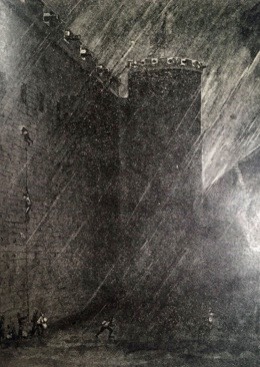
The night was dark and a cold rain was falling, which caused the guards to seek the light and warmth inside the castle. At seven o'clock the flight began. The thin shell of the wall that had been left on the outer side of the breach was removed and a rope, by which the prisoners could lower themselves to the bottom of the moat, was fastened on the inside and passed through the opening. It was now discovered that the breach on the outside was too narrow for any but the smallest men to pass through, and it required two hours' work to enlarge it.
"All things being now ready," continues General Green, "John Toowig got into the breach feet foremost, and, drawing his bundle after him, inch by inch squeezed himself out and let himself down hand over hand about thirty feet to the bottom of the moat. The depth and the smallness of the hole rendered this operation exceedingly slow. At half-past twelve o'clock, after three hours and a half of hard labor, all of the sixteen had safely landed.
"As Isaac Allen made his appearance at the outer aperture, he said, 'Stand from under, boys; I can't say whether these hands are going to hold'; and no sooner said, than down he came right in the midst of us. The sand being about ankle-deep, it was an easy fall, and he rose as if nothing unusual had occurred. Ike had previously had the contents of his gun passed through both hands, which weakened his hold, and was the cause of his falling.
"When Samuel Stone's turn came, being a large man, he stuck fast in the hole and could neither get backward nor forward. In this situation, the prisoners on the inside of the room, who were assisting in the escape, had to reach into the hole, tie ropes to his hands and draw him back. But he had no intention of being left. 'I have a wife and children,' he said, and I would rather die than stay here longer; I will go through or leave no skin upon my bones.' He then disrobed himself, and, making a second effort, with great labor succeeded in pulling himself through; but he left both skin and flesh behind."
Shortly after midnight they had crossed the moat and the outer wall of the fortification and found themselves in the open country surrounding Peroté. They were free men once more. A cheer rushed to their lips, but was quickly suppressed; and instead they gave vent to their joy by jumping up and cracking their heels together three times.
Arrangements had been made for a guide and horses to take them to Vera Cruz, where they expected to ship for home; but the guide failed to meet them, and they were obliged to keep to their first plan of escaping in pairs. There was no time to be lost, so, wishing each other a safe journey and giving a hearty handshake, they separated.
We cannot follow all of these parties; it would make our story too long. One-half the number succeeded in making good their escape, and after many exciting adventures reached Texas; the rest were soon recaptured and taken back to the castle, where for another year they had to endure every insult and indignity that their inhuman jailers could invent. The remaining prisoners in Peroté, who had not attempted to escape, were released by Santa Anna, September, 1844, at the dying request, it is said, of his young and beautiful wife.
General Green's account of the escape of his party, consisting of himself, Daniel Henrie, Charles K. Reese and John Toowig, is full of interest:
"Myself and Dan took the road for Vera Cruz, proceeding at a brisk walk, occasionally stooping low, and surveying the horizon to see whether anyone was moving. When about three miles from the castle, and near a powder-house, many dogs flew out as if they would certainly bite us. We knew how cowardly Mexican dogs were, however, and kept on our way, balancing our sticks in our hands in case we should have to use them.
"About five miles farther on, Reese and Toowig, who had gone ahead for the guide and horses, having been disappointed in their mission, joined us and we made for the mountains.
"The only shoes we could get in the castle were a kind of thin goatskin slippers, fit only to be kept dry and worn in the house. In a little while, as we walked through the wet grass --- a heavy rain had fallen --- they became soaked with water, stretched and fell to pieces. Our feet suffered much from the sharp mountain stones; and as we had become greatly weakened by our prison life, the labor of mountain climbing was very fatiguing. Before it was fairly light we had reached a point some distance above the settlements; and our tracks having been effaced by the rain, we felt reasonably secure; and selecting a dark cove we lay down to rest.
"It was near sundown when we resumed our journey, thinking it more safe to travel by night than by day. But we escaped one danger only to fall into another. Our course lay over an excessively broken country. Inaccessible mountains and bottomless ravines followed hard upon each other, and, at times, stopped further progress.
"We usually traveled single file, each in turn taking the lead. One dark night, when it was my turn to lead, we fell into a level path, which we pursued several hundred yards. We could not see the length of our arms ahead of us, so I kept the end of my walking stick about two feet ahead of me, feeling the way. At length I felt no bottom. I stopped as quick as thought, and drawing back a step, called to my companions to halt. Then, stooping down, with my stick I reached as far as my arm would allow, but still found no bottom. Lying flat on our faces and strain ing our eyes, we discovered what we took to be the tops of trees far below. This discovery gave us a great fright. We were on the brink of one of those frightful precipices, and a single false step might plunge us headlong into the depths. We now changed our course and felt our way, inch by inch, down a deep descent of at least a mile into a valley which lay at the base of the precipice. Even as I write the remembrance of that dreadful situation unnerves me. One step more and myself, then Reese, and then Dan would have fallen a thousand feet—for no alarm from the foremost would have reached the next — leaving no one on earth a knowledge of our destiny.
"Daylight found us lying under our wet blankets in some thick bushes. Here we rested a few hours, being much exhausted and suffering greatly for want of refreshment. In our descent from the mountain we frequently slipped and fell with great violence; and our feet and legs were skinned, swollen and very sore. From a small creek running near by our hiding place we got water and, lighting a fire, made cup after cup of coffee, which greatly relieved us. We then bathed our bruises and had a good chat, the first since we left the castle, which restored our spirits and strengthened our courage to proceed on our journey.
"From the distance and general direction that we had traveled, we believed that we were not far from the city of Jalapa; and we had not gone many miles from our cooking place when our conjecture was found to be correct. We heard the ringing of the city bells, of which there are great numbers in every Mexican town, and by the bright moonlight saw the city itself spread out before us, resting peacefully in the lap of the mountains.
"It was our plan to leave the city to the right, strike into a river valley, which our map showed led to the seacoast, and thence follow it down.
"We bore to the left to avoid the city, but soon found ourselves in a maze of stone fences covered with briers and prickly pear by which our feet were cruelly lacerated. The farther we proceeded, the thicker, it appeared to us, became the settlements; so we resolved to play our game boldly and strike for the heart of the city.
"Indian file we passed up one street and down another, our broad-brim sombreros pulled down over our eyes and our shoulders and knapsacks covered with blankets, after the fashion of the Mexicans. To the frequent challenge of the sentinels we made no reply, but kept our course in silence. It appeared to us that there were more dogs in this town than we had ever before seen in one place. They flew out at us, barking in an angry tone, as if they knew us to be strangers, yet keeping at a respectful distance from our sticks.
"After wandering about the city till near daylight, we withdrew to the outskirts to seek a hiding place for the next day. A little round-top hill, rising out of the valley south of the city, we found just suited to our purpose. It was covered with high weeds and brush, and, from its appearance, was not often ascended. Here in our wet clothes and blankets — a cold, drenching rain had fallen — we lay down on the wet ground and tried to get a little rest and sleep.
"We remained here till next evening, when, as it was growing dark, we returned to the city. Coming to an old church, around which grew some high weeds, Reese and I seated ourselves by the wall in the weeds and sent Dan ahead to find the house of a friend who had promised us aid. In a short while Dan returned, bringing Don ------ with him. The Don was expecting us and took us home with him, where we found his good wife preparing us a warm supper.
"We remained with these good people five days and were treated with a kindness we shall never forget. They gave us the best of food and all kinds of delicious fruits. Our feet and legs were bathed and poulticed; and we sent out and bought good shoes and other things necessary to our further journey. By the sixth night we were so far recovered from our mountain fatigues as to be able to proceed.
"At ten o'clock on this night the Don said to us, 'Prepare to follow me and ask no questions.' We did so, and he led us through the city into a dark valley about two miles off, and telling us to hide in the bushes here, he went farther on down the hollow. When about a hundred yards away he gave a shrill whistle, which was immediately answered, and we saw — the moon being bright — a tall, active, well-made man spring from the rocks and join him. After exchanging a few words, they came in the direction of our hiding place and called to us to come forth. 'This man,' said the Don, 'will conduct you to Vera Cruz. Follow him but ask no questions. You need have ho fear of his betraying you, as he is one of the most noted robbers in Mexico and he dare not show himself to the authorities.' So saying, and wishing us godspeed, the generous Don returned to the city and we followed our mysterious guide down the hollow.
"We had gone but a short distance, when, in a dismal-looking place in a cross hollow, we came upon a confederate of our guide holding mules, which were to be our conveyance to the seacoast. Without speaking, the head man placed a bridle in our hands; we mounted and followed on a narrow, winding path leading through deep ravines and broken cliffs until daylight, not one word passing between us on this long ride.
"Our robber guides now left us, leading away the mules and promising to return at night to resume the journey. We hid ourselves in a thicket, as usual, and, after eating of the provisions left by our guides, lay down on the ground and slept soundly till near night.
"Our guides returned at the appointed time. At a sign from them we mounted our mules and followed in silence as we had done the night before. Nearly the whole of this night we rode in a heavy rain, and part of the time in a tremendous storm. Our path was narrow, rugged and, at places, quite precipitous; and so winding that in the darkness we appeared to be merely zigzagging about without making any progress. We gave our mules free rein and they, as if conscious of their responsibility, picked their way over ground that would have been impassable to any other animal."
The fifth night of their journey, the travelers drew near to the city of Vera Cruz, after having narrowly escaped recapture by a squad of cavalry that had been sent to intercept them, and death from a sandstorm that well-nigh buried all hands. Their robber guides had proved true, and the next night conducted them to the house of a friend, with whom they were to lodge until a vessel should sail for the United States.
This friend, like the one at Jalapa, received them with the greatest kindness and in every way ministered to their comfort. But no boat was in port, and it was uncertain when one would arrive; so the Texans were little better than prisoners still. They were obliged to confine them selves to a small room in their friend's house and dared not go out for fear of detection.
The weather was swelteringly hot and, to make matters worse, yellow fever was epidemic in their quarter of the town, and scores of people died of it every day. Sitting in their dark room — there was but one window in it — listening from morn till night to the dismal tolling of the bells for the dead and the continuous rattle of the death- cart beneath their window, what wonder is it that the prisoners soon fancied the dreadful malaria coursing through their veins?
In this pest hole our friends remained for thirteen days. Then came a knock at their door, followed by the en trance of their host, who announced that a vessel from the United States was in port and would sail early next morning for New Orleans.
The captain had been informed of the arrival of the Texans in Vera Cruz and of their hiding place, and that night sent a detail to fetch them on board. About nine o'clock the party reached the landing without accident and slipped into the little boat which was to convey them to the American vessel. They were challenged by three Mexican men-of-war lying in the offing, but, at the risk of being fired upon, they made no reply and soon pulled alongside the American ship and clambered on board.
The commander of the vessel, Captain Lloyd, was an old friend of General Green and gave him and his men a hearty welcome. On board they found three others of the party that had escaped with them from Peroté — Cornegay, Forrester and Barclay. The two former had shipped as firemen and were standing below with smutty faces and red flannel shirts, as though they had been brought up to the business.
'"We had a good sleep this night," says General Green, "and early the next morning the captain told me he would go ashore with his boat and, when the inspecting officer started to come on board, he would make a signal at which I was to go below and crawl under the boilers. Steam had been up half an hour, when Lloyd made the signal. I went below and crawled into the darkest, hottest place imaginable. Every five seconds I had to turn over to keep from burning to death. I was willing to take a scorching, as I had determined not to be carried back to prison alive."
This ordeal over, with a smooth sea and a clear sky, the ship weighed anchor and after an uneventful voyage of eight days moored at the wharves of New Orleans. Two days here and then our friends are again on the deep, blue sea, this time bound for the mouth of the Brazos and home! And here let us take leave of them. Of all that noble band, some rest in the shadow of the dungeons of Old Mexico; some in Texas sleep, and
Some on the shores of distant lands
Their weary hearts have laid,
And by the stranger's heedless hands
Their lonely graves were made.
But their fame lives on and will continue to live so long as patriotism, bravery and self-sacrifice are virtues honored and revered among men.
Chapter 12 - Brave Dick Dowling
==========