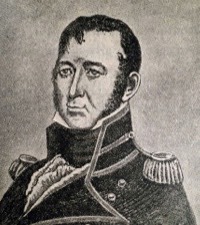
ELLIS P. BEAN
One hundred years ago, it will be remembered, Texas was a province of Spain. Spain was jealous of her colony and would not allow people from other countries to settle there. The people of the United States, in particular, were refused admittance. One of the Spanish commanders said that if he had the power he would stop even the birds from flying across the Sabine River.
At this time there were only three or four American families in all Texas, and they had become subjects of the king of Spain. In 1797, a young American named Philip Nolan came to Texas to get horses for the United States army. Thousands of wild horses roamed over the plains, and belonged to anyone who could catch them. Nolan soon got together a herd of two thousand and returned to the States with them. He made a map of the country, through which he traveled, and this was the first map of Texas ever made.
Three years later, with a party of twenty men, Nolan came back to Texas for more horses. The Spaniards had heard of the map he had made. They thought he meant to bring an army into Texas, and that this map was to be his guide. He was declared to be a dangerous character, and a company of soldiers was sent to arrest him. He would not surrender, and a fight took place. At the first fire Nolan was killed. The remainder of his party surrendered on promise of good treatment.
Among the prisoners was a young man named Ellis P. Bean. He was born in Tennessee in the year 1783. This was three years before the birth of David Crockett, who was also born in Tennessee. Like Crockett and Houston and other boys of that early day, he received very little schooling. When he left school, he could barely read and write.
When he was sixteen years old, he panted to leave home to visit other countries. His father said he was too young, and would not allow him to go. But at last his wish was granted. His father sent him down the Tennessee River on a trading voyage with a boat load of flour and other western produce.
Bad luck attended him. When several hundred miles from home, at a place called Mussel Shoals, his boat struck on a rock and broke in pieces. Everything was lost except a small trunk of clothes. With only five dollars in his pocket, he resolved to continue his journey. Now was his chance to see the world. To be sure, his money would take him no great way, but when it gave out he could stop and work for more.
Another boat soon came along bound for Natchez, on the Mississippi River. Bean was taken aboard, and in a few days was landed at Natchez. He had an aunt living there, to whose house he went. His aunt was very kind to him, and told him he must live with her. But he soon grew tired of this place. He wanted to travel and see more.
About this time he met Philip Nolan. Nolan was getting ready for his second trip to Texas. He begged Bean to go with him. He told him of his adventures on his first trip; how he hunted the buffalo and how he chased the wild horses over the prairies. This was the very kind of life for which Bean longed, and he readily agreed to join Nolan's party. We have seen how this party was captured by the Spaniards.
The prisoners were taken back to Nacogdoches, where they were told they would be set free. In this hope they waited about a month. Then, instead of the expected freedom, they were put in irons and sent off under a strong guard to San Antonio.
Here they were kept in prison for three months. Then orders came for them to be sent to the City of Mexico. They were stopped on the way at a place called Potosi, where they were confined in prison for more than a year.
All this time they were kept in irons and otherwise cruelly treated; they were poorly fed; their clothes were worn into shreds, and they had no money to buy more. Bean told his guards that he was a shoemaker, and asked permission to sit at the door of his prison and work at his trade. In this way he made a little money.
In a short while Bean and his companions were changed to another prison, and then to another. They were thankful for the change. Prison life was not so terrible with something new to see, to think of, and to talk about. At the town of Chihuahua their irons were knocked off and they were told that they might walk about the town, but that they must return at night to sleep in the soldiers' barracks.
Here Bean gave it out that he was a hatter. A gentle man loaned him some money, with which he set up in business. He knew nothing about making hats himself, so he hired two Spanish hatters to work for him. "In about six months," he said,"I had so raised my name that no one would buy hats except of the American." He hired other workmen, and was soon making fifty or sixty dollars a week. He laid aside this money to aid him in es caping to his own country, which he was resolved on doing at the first opportunity.
It was four years before an opportunity was offered. Bean wrote a letter to a fellow-prisoner living in another town, telling of his plans, and asking this friend to es cape with him. This letter fell into the hands of the governor, who at once had Bean arrested and thrown into a dungeon." He was heavily ironed and not allowed to see or speak to anyone.
The day after his arrest he was surprised to see his prison door thrown open and one of his companions brought in sick on a litter. He had asked to see Bean before he died. It would be a comfort, he felt, to die in the company of a countryman.
Five or six days afterwards a big Indian was brought into the same cell where Bean and his companion were confined. The sick man was now very low. Bean expected him to die every moment. The Indian had brought a Jew's-harp with him, on which he played all the time. This greatly disturbed the sick man. Bean asked the Indian in a friendly manner not to make the noise. The Indian answered that it was his harp and he would play when he pleased. Bean then went up to him and snatched the harp away from him and broke the tongue out. This made the Indian very angry, and he attacked Bean. The Indian was more than a match for Bean in size; besides, he was not so heavily ironed. Bean kept cool, however, and with a few well-aimed blows soon laid the Indian at his feet quiet and motionless.
Three days afterwards Bean's friend died and was carried away to be buried. Bean was again left alone, and for three months saw no one except the jailer. At the end of this time his irons were knocked off, and he was told that he might walk about the town as before. But this was a short-lived freedom. In less than two weeks he was again in his cell loaded down with irons. In a few days his companions who were still living were brought in, all heavily ironed like himself, and put in the same room with him.
What was to be their fate none could guess. When they were first arrested, five years before, their case was taken to the king of Spain. All these years they had been kept prisoners waiting for the king's decision. At last it had come. One morning an officer came to their prison and read to them the king's orders. These orders were that for firing on the king's troops every fifth man was to be hanged. As there were only nine of the prisoners, it was decided that only one had to die.
Who would be this one? How was it to be decided? Some of the men were very much cast down and showed great fear. Bean tried to cheer them up. He said: "I told them that we should not fret ourselves about what we could not help; if we could find no way to escape the grave, it would be better to march up to it like a man than to be dragged to it like one dead; and as for myself, if I must die, I meant not to disgrace my country."
A drum, a glass tumbler, and two dice were brought into the room, and the men were told that they must throw for their lives. The oldest was to throw first and the youngest last. The one that threw the lowest was to die.
The men were blindfolded and led to the drum. One by one they cast the awful throw of life or death. Bean, being the youngest, threw last. When all had finished, it was found that Ephraim Blackburn, the oldest of the prisoners, had thrown the lowest. The next day, after baptism by a priest, he was taken out and hanged.
In three or four days orders came that Bean and four others were to be carried to a strong fortress at Acapulco, more than a thousand miles to the south. The rest were set at liberty.
After a trying journey of many weeks Bean and his companions found themselves at Acapulco, a seaport town on the southern coast of Mexico. Its water front was guarded by a great stone castle. The walls of the castle were six feet thick and surmounted by one hundred great guns.
The prisoners were taken to the castle, where their names were called to see if all were present. When Bean answered to his name he was told to step to the front. He did so.. Then an officer took him to the side of the castle, and, opening a small door, told him to go in. The door was then shut, and. he was left alone with his thoughts.
He found himself in total darkness. When his eyes had become somewhat used to the darkness, he looked about him. He was in a room about as long as a common bedstead and not quite as wide. On all sides of him were the solid stone walls. At one end of the room was a small opening, grated with iron bars, which let in a little light and fresh air. In the door was another opening, also grated, about the size of the palm of a man's hand.
In the evening an officer brought him a mat for a bed, some beef and bread, and a pot of water. For eleven months he was buried in this dungeon. He was allowed to speak to no one and to see no one but his jailer. Once a day the jailer brought him beef and bread and water.
Besides the loneliness and the darkness, he was tortured by the terrible heat of this climate. At times his dungeon seemed like an oven. He would sit for hours with his mouth at the little grated opening in the door, panting for a breath of fresh air.
He had told his companions, "There is no use in fret ting over what cannot be helped." He now took that advice to himself. He did not fret or worry. He believed he should escape, though he knew not how. Not once did he think of giving up. He determined to do everything in his power to free himself. Though the walls were six feet thick he thought of boring through them. Inch by inch he examined the walls for some crack or opening where he might begin his work. He searched every corner of his cell, many times over, for a nail, a piece of iron, or stone that could be used in boring. He could find nothing.
One day a soldier on guard spoke kindly to him. Bean took this for a good omen, and asked the soldier to sell him a small knife, at the same time giving him a dollar. The soldier promised to do so, and, when night came, slipped the blade of a knife through the hole in the door.
Bean's spirits rose. He held the knife at arm's length in the light in the window and looked at it lovingly. Now he would be free! Though the walls were twice as thick he would cut through them! Alas for human hopes! The prisoner set to work with a will. The stones were so hard that he could make no impression upon them, and they seemed to grow harder with every stroke he made. The knife blade wore away faster than the stones. He tried several places in the wall in hope of finding a softer stone, but all were equally hard and unyielding.
Bean threw himself on his mat to think. His eyes were still fixed on the wall. In the dim light he thought he saw something moving across the wall. He put his hand to his eyes and looked more closely. It was a large lizard.
The lizard was snow-white and nine or ten inches long. It was engaged in catching flies. Bean was glad to have even a lizard as a companion. In watching it he forgot for a while his prison and its terrible loneliness. His dungeon seemed less cruel since there was some living object to share it with him.
He caught some flies and reacheS them up to the lizard on a straw which he pulled from his mat. He was de lighted when he saw the lizard would take them off the straw. He kept this up for several days, until the lizard became so tame that it would take the flies from his hand. Every morning as it came down the wall it would sing like a frog to let Bean know it was coming. In a little while it grew so gentle that it did not leave Bean at night, but stayed with him all the time.
One day Bean learned from the guard that some of his companions were sick and had been sent to the hospital. Bean thought that he might be sent there too if he were sick, and that on the way he might find some means of escape. So he told the guard that he-was sick, and asked . that a doctor be sent for. When he heard the door open ing he struck his elbows against the stones, which raised his pulse so high the doctor thought he had a fever, and ordered him sent to the hospital. A big Indian carried him there on his back.
He still had on his irons, but to make sure of him his legs were put in stocks. The stocks were two large logs of wood fitting one upon the other, with, half-circular holes in each for the prisoner's legs. To make a bad matter worse, thousands of insects crawled over his body and bit him day and night.
Bean soon came to think that the castle and his lizard were more to be desired than the hospital with its insects and stocks. On the morrow he would say he was well and go back to his cell. But that night he was taken with a real fever, and was ill for twenty days.
When he got well, he was started back to the castle guarded by two soldiers. His irons had been knocked off, but in their place a chain of about fifteen pounds' weight was fastened to each leg. He could walk only by wrap ping the chains about his waist. His illness had left him very weak, yet he determined to escape from prison at the first opportunity.
The party stopped at an inn by the roadside to get some refreshments. The soldiers, not thinking that a man, weak and chained as Bean was, would try to escape, did not watch him very closely. While they were busy eating and drinking, Bean escaped through the back door and made for the woods near by.
With a piece of steel which he had for striking fire, he cut off his irons. Then, he says, "I sat down in a shady grove, where the singing of birds and the thought of being at liberty so charmed me that I was as happy as any king. Though I had been starved in the hospital I did not feel hungry, nor was I weak."
At night he made his way back to the town and bought some bread, bacon and cheese. As he was passing by another shop, he heard within the sound of men's voices, speaking in English. He stepped inside and found two Irish sailors who belonged to a ship that was lying at the wharf.
The sailors took him to the captain of the boat, to whom Bean told his story. He told the captain that he was an American; that he was an escaped prisoner; that he wanted to leave this country and go with him on his boat. The captain said he would take him, but he must hide himself until the next day when the ship sailed.
Bean went back to the woods, where he stayed that night and all the next day. When night had come again, he went to the place where the sailors had agreed to meet him. The sailors were waiting for him. They dressed him in sailor's clothes and took him on board the vessel.
The boat was partly loaded with water pipes. Some of these were large enough for a man to crawl through. Bean was put into one of these pipes, to hide him till the boat should sail. The governor had heard of Bean's escape and was searching everywhere for him, but could not find him. Soon after the guard left, the boat's cook, who had had a quarrel with the Irish sailors, went ashore and told the guard that he would show them where Bean was.
The guard came back on board and the cook showed them the pipe in which Bean was hidden. Bean was dragged out and tied so that he could not move. He was then thrown from the vessel down into a small boat, which took him back to the city. Then he was carried to the castle, where he was ironed and placed in his cell. This time he was almost ready to give up. There was no use trying to escape. It was his fate, it seemed, to pass the remainder of his days in a Mexican dungeon. If he should stop trying to escape, he might be treated better. Then other thoughts came. He remembered his few hours of freedom before going aboard the ship. The breath of the woods came floating in upon him. He called to mind the cool, shady nooks where he had rested him self; the delicious fragrance of the flowers; the joyful singing of the birds.
No, he would not give up! While there is life there is hope. One hour of freedom is worth an eternity of striving to be free. His mind being at ease, Bean 'looked around for his lizard. There it was on the wall, but it seemed to be afraid of him. He reached up his hand for it, but it ran away. Bean fed it with flies, and in four or five days it became as friendly as ever.
One year and five months passed. Then one morning an officer came to examine Bean's irons, to see if they were secure. Bean heard the officer tell the guard at the door that he must have some rocks blasted. The guard answered that there were men enough to bore the holes, but no one who understood charging them. Bean's heart leaped into his throat. Here was one more chance of escape! He spoke up quickly and told the officer that he knew all about blasting. The officer made no reply and Bean's spirits fell as suddenly as they had risen.
Bean thought no more about the matter and was very much surprised three or four days afterward to get orders from the governor to go and blast the rocks. His irons were taken off and a ten-foot chain was" placed on each leg. He wrapped the chains about his waist and, with two soldiers as a guard, started for the quarry. He found about fifty other prisoners at the quarry and only twenty soldiers to guard them. Bean quickly saw that here was another chance to escape. When the prisoners were taken to their quarters for the night, Bean told them of his plan. He had already bought arms which would be given to them secretly next day. When they saw him carrying a basket of stones on his shoulder, they must be ready. He would try to take a gun from a soldier, and they must do the same.
Bean slept sweetly that night. He was sure that his plan would succeed. On the morrow he should taste the delights of freedom once more. His dreams were of singing birds, and trees and flowers; of home, a father's fond welcome, a mother's caress.
Morning came. The prisoners went to their work. The signal for the attack was given. The soldiers fled at the first onset. Bean and an old Spaniard, who had come with him from Natchez, made off together. Another squad of soldiers tried to cut off their escape; but Bean with a gun, and the old Spaniard with a hatful of stones, made them retreat. A parting shot from the soldiers broke the old man's thigh, and Bean had to leave him to be recaptured.
Bean ran on till he came to a mountain, which he climbed. Here he sat down to rest and think what he should do next. His first thought was of his old friend, the Spaniard, whose loss grieved him very much. In the excitement of the battle and the chase, he had almost forgotten his chains. The next thing to do was to remove them. He had a razor and an old knife blade which he struck together and made into saws; and with these he quickly freed himself.
As he was pondering which way he should go, he saw a soldier coming toward him up the mountain side. This gave him a great fright. Bean raised his. gun, but the soldier told him. not to shoot as he was a friend. When he had come nearer, Bean knew him and was very happy to see him. The two men now set their faces toward the north and began their journey to the Land of Freedom. For fear of meeting soldiers and being recaptured they left the main road and took to the woods. They traveled very slowly, as the woods were thick with vines and underbrush through which they had to cut a path. For two years Bean had walked very little and his feet were tender. They soon became blistered and the skin came off. "They were very painful," he said, "but the thought of being free made me the happiest man in the world."
At one time they were pursued by soldiers and escaped by plunging into a lake which was full of alligators. Often they had nothing to eat but the tender buds of the cabbage tree.
Once more fortune played him a trick. One night just as Bean and his companion had crossed a small stream, thirty men rose up on the farther bank and ordered them to surrender. Bean was determined to die rather than surrender. Death was more to be desired than life in a Mexican prison. So with only a stick for a weapon he charged the enemy. The next moment he was knocked senseless by a blow on the temple. When he came to himself, he was so" strongly bound that he could move neither hand nor foot. Next morning horses were brought and he was taken back to Acapulco and the castle.
This time he was chained to a large mulatto negro and put in a room with some twenty other prisoners. The mulatto was told to whip him if he did not obey. One morning they were taken into the castle yard to eat break fast. As Bean reached for his bread, the negro jerked the chain and threw him over. Near by was half a cow's skull with a horn on it. Bean seized this and with one blow knocked the negro down. He kept on beating him till the guard came and took the skull away. The mulatto begged to be let loose, and they were separated.
Bean now had a wheel put around his neck. "It was so large," he says, "I could not reach the rim of it. Of all the modes of punishment this was new to me. I could not move with it." After four hours of torture the wheel was removed and he was taken back for the third time to his little cell and his lizard.
The keeper of the castle feared that he would escape again and this time for good. So he wrote to the governor of the country and asked that Bean be sent to some other prison. The governor gave orders that he be sent to Manila in the Philippine Islands, ten thousand miles across the great sea. He was to go in the first ship that sailed. Bean was pleased to hear this news. He knew that savages lived in that country, and among them he hoped to find some chance to escape.
At this time the Mexican people were trying to free themselves from Spain. They were led by a priest named , Morelos. Both sides needed soldiers. People from the United States came to the help of Morelos. The Spaniards opened the prison doors and set at liberty all prisoners who would promise to fight for the king of Spain.
Bean was the only one left in the castle at Acapulco. The Spaniards wanted his help, but they feared to trust him. One day an officer came to his cell and asked him if he would fight for the king. Bean told him he would gladly do so. His irons were then knocked off and a gun was put into his hands.
Bean did not mean to fight for the king longer than he was obliged to. His heart was with the people. He knew the wrongs they had suffered and he wanted to see them free. After all he had undergone, the king's service was hateful to him. He was determined to leave it at the first opportunity and join the patriot army.
The opportunity soon came. Bean with seven others was sent to find out where Morelos was. When his camp was found, Bean left his companions at a farmhouse and went on ahead to learn what he could about the enemy.
He met a company of Morelos' soldiers to whom he gave himself up as a prisoner. He told where his companions were and they were taken also. Bean was bound fast, so that his companions should see that he was a prisoner.
Bean told Morelos that he had come to fight with him for the liberty of the country. He was given command, of a company and fought bravely through the war. At one time he captured Acapulco and the governor of the castle who had treated him so cruelly. Another time he was offered ten thousand dollars to fight for the king. To the officer who made the offer Bean wrote this reply: "I have to state that I am very poor but, for all that, your king has not money enough to buy me or make me a friend of a tyrant, when I have been rocked in the cradle of liberty from infancy."
When the war was over, Bean visited his old home in Tennessee. Almost twenty years had passed since he went away to see the world. His father and mother were dead. The friends of his boyhood days had grown up to be men and women. Few remembered him. He was a stranger in the land of his birth.
With a saddened heart he returned to Mexico, which was henceforth to be his home. He married a rich Mexican lady, with whom he lived quietly and happily until his death in 1846.
==========