SAM HOUSTON
Sam Houston was born near Lexington, Rockbridge county, Virginia, on the 2nd of March, 1793.
His father, Major Samuel Houston, was a soldier of the Revolution. He served throughout that struggle in General Daniel Morgan's famous band of riflemen, and won much credit for his daring and courage. Major Houston was a tall, powerful man, brave as a lion, and never more at home than when fighting the enemies of his country, the red-skinned savages or the red-coated British.
Sam's mother was Elizabeth Paxton, a good and noble woman. She was known the country round for her kind ness and helpfulness; and her name was always spoken with gratitude by the poor and suffering.
The Houstons lived on a small farm seven miles from the town of Lexington. The family consisted of nine children, five boys besides Sam, and three girls. • As soon as the children were old enough to work, the boys were sent to the fields to assist their father in ploughing, hoeing and harvesting, while the girls stayed at home to help their mother with her household duties. Wealth was not theirs but they were plentifully supplied with the com forts of their time and blessed with vigorous health.
When Sam was eight years old he started to school. There were few good schools in Virginia in those days and no free schools such as there are to-day. Houston at tended an "old field school" in an old building, located on the present site of Washington and Lee University. He could go to school only in the late fall and winter; the rest of the time he was kept hard at work. He learned to read and write and to do "sums" in arithmetic. When he was thirteen years old he had gone to school but six months in all. At this time his father died.
After the death of her husband, Mrs. Houston sold the old home in Virginia, and with her young family moved across the Allegheny Mountains into Tennessee. The journey was a long and dangerous one. High mountains, trackless forests and swollen streams obstructed the way. Ferocious wild animals lurked in the hollows of the hills and crouched among the branches of the trees, ready to spring upon the unwary traveler. In the shadow of every rock prowled a murderous savage with tomahawk poised and ready to fall, and scalping knife keen for the warrior's trophy, the scalp lock of his enemies.
But nothing daunted, this brave woman, with her few household goods and smaller children on pack horses, set out on foot for what was then considered the Land of Promise. After many days the little party halted in what is now Blount county, eight miles from the Tennessee River, which was the boundary between the white men and the Cherokee Indians. Here a log cabin was built, a farm cleared, and life begun over again.
Sam was now set to work with his brothers breaking up the soil and planting the crops that were to furnish subsistence for his mother and sisters. But hard work had no charms for him. He liked hunting and fishing better. He soon became acquainted with the Indians living near his home, and spent much of his time in the woods with them. This conduct was very displeasing to his elder brothers, who complained that he was not bearing his share of the family burdens. After much argument and persuasion he was put to work in a country store.
Sam had no greater liking for this kind of life than he had for farming; so one day he suddenly disappeared. Diligent search was made for him for many weeks, and he was found at last with a band of Cherokee Indians who lived across the Tennessee River. His brothers visited him and tried to persuade him to return home; but he replied that he preferred measuring deer tracks to measuring tape, and they might leave him in the woods.
Only when his clothes were worn out, and he was in need of more, did he return home. His mother received him kindly and fitted him out in the best she could afford.
His brothers, too, for awhile treated him with due respect, and tried to prevail upon him to give up his wild notions. But he could not forget his free life in the woods. He longed to sport with the happy Indian boys; he longed to chase the deer; he longed for the fresh air of the forests; and he was soon back among the Indians.
Sam was very fond of reading, and he took with him to the woods his favorite book, Homer's Iliad. This he read by the light of the Indians' camp-fires at night, and in the daytime, when the chase was ended, he would lay himself down under the shade of a great tree and read for hours and hours. He remained with the Indians till his eighteenth year.
On his visits home he had bought ammunition and many little trinkets for his Indian friends, and for these things he now found himself in debt. He could think of only one way of paying off his debt: he would give up his dusky companions and teach the children of the palefaces. As may be supposed, it was no easy matter for him to get a school. He had few pupUs at first, and for a time it looked as though his venture would prove a failure. But he was not one of the kind that gives up. He kept right on, and soon had pupils to turn away. For pay he received corn, cotton cloth, and a little money.
Having made money enough to pay off his debts, he shut up his school and soon after became a soldier in the United States army. Because he enlisted as a common soldier, his friends said that he had ruined himself and disgraced his family, and they cut his-acquaintance at once. Then it was that he made his first speech: "And what have your craven souls to say about the ranks? Go to, with your stuff; I would much sooner honor the ranks than disgrace an appointment. You don't know me now, but you shall hear of me."
His mother encouraged him, telling him that by honorable effort he might win success and promotion. Stand ing in the door of her cottage, she handed him his musket, saying: "Here, my son, take this musket and never dis grace it; for remember, I had rather all my sons should fill one honorable grave than that one of them should turn his back to save his life. 'Go, and remember, too, that while the door of my cottage is ever open to brave men, it is always shut against cowards." It was not long be fore he became a sergeant; then the best drill officer in the regiment.
The powerful tribe of Creek Indians of Alabama, in cited by the great chief Tecumseh and his brother, the Prophet, had fallen suddenly upon the white settlements and committed a frightful massacre at Fort Mims (August 10, 1813). General Andrew Jackson was sent with an army to punish the Indians and restore order. Houston's regiment joined this army and marched into the enemy's country.
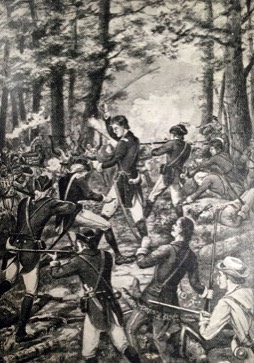
In the great battle of Tohopeka, or "the horseshoe," General Jackson met and defeated the Creeks and broke their power forever. It was a bloody hand-to-hand, muzzle-to-muzzle fight that, lasted all day. The Indians had been told by the Prophet that the Great Spirit would fight on their side and sweep away their enemies in a storm of wrath; and so they fought to the death, ever looking for the appearance of their champion. Not a . warrior asked for or received quarter.
While leading a charge on the Indians' breastworks Houston was struck by a barbed arrow, which sank deep into his thigh! He tried to pull it out and failed. He then called upon his lieutenant to pull it out; but after two trials he, too, failed, so deeply was the arrow embedded in the flesh. "Try again," said Houston, raising his sword, "and if you fail again I will smite you to the earth." This time the arrow came out, followed by a stream of blood, tearing the flesh and leaving an ugly wound that never got entirely well.
While his wound was being dressed, General Jackson, who had been watching the fight, rode up and ordered him to the rear. Houston made light of his wound and begged to be allowed to re-enter the fight, but was refused. He had said to the people when leaving home: "You shall hear of me." This was the place and the hour to make that promise good. He determined to^die in this battle or win the name of a hero; so when Jackson moved off he rejoined his men and was soon in the thickest of the fight again.
When the day was almost done, and the battle was thought to be over, the Indians who survived the slaughter took refuge in a deep ravine, from which they poured a galling fire upon the whites. The only way to dislodge them was by a charge upon the narrow entrance of the ravine. This was a desperate undertaking, and would probably cost the lives of the men who made it. General Jackson called for volunteers to storm the ravine. Wounded as he was, "Houston dashed forward, calling upon his men to follow him, but without looking back to see if they did so. When within but a few yards of the entrance he received two bullets in his shoulder and his upper right arm was shattered. His musket fell from his hand, and he was helpless. No one had supported his charge, and he drew back out of range of the fire."
Houston was thought to be dying when he was borne from the field, and little attention was given to his wounds. He lay on the damp ground all night, racked with pain and expecting every moment to be his last. The next morning, being still alive, he was placed on a litter, and, with the other wounded, was taken to Fort Williams, some sixty or seventy miles away. For quite a while he remained here, neglected and exposed, and suspended between life and death. Nearly two months after the battle of Tohopeka, he was carried back to his mother's cabin. He was worn to a shadow, and so changed that his mother said she would not have known him to be her son except for his eyes.
After the war was over, Houston was promoted to the position of first lieutenant and ordered to New Orleans. With only two companions he made the journey down the Cumberland and the Mississippi rivers in a small skiff. One day as their skiff was turning a bend in the river, they saw a strange sight — a vessel coming up stream without any sails and sending up a dense column of smoke. They thought it must be on fire; but on coming closer they saw it was a steamboat — the first that had ever gone up the Mississippi River.
After five years' service in the army, Houston resigned his commission in May, 1818. His record as a soldier was one of which he might well be proud. He had earned the respect and commendation of those in authority over him, and was noted throughout the army for his devotion to duty. His bravery at Tohopeka attracted the notice of General Jackson, who became his lifelong friend. General Jackson, writing to another officer, said of him: "In him I have full confidence, and in him you will have a friend without design or deceit." Colonel Thomas Benton, the colonel of his regiment, said in a great speech: '" He is frank, generous, brave, ready to perform every duty, and always prompt to answer the call of honor, patriotism, or friendship." This was high praise for a young man of twenty-six years.
Houston now returned to Tennessee, and made his home in the city of Nashville. Here he began the study of law, and in six months was admitted to practice in the courts of the State. He practiced law as he had practiced war— with his whole heart. He made himself popular with all classes of people, and rose rapidly to distinction.
When only thirty years of age he was elected to Congress. At the end of his term the people were so pleased with his course that he was returned a second time, almost without a vote being cast against him. But he was to rise higher yet. His course in Congress won for him the respect and confidence of the whole people of Tennessee. Save Andrew Jackson, no man in the State was more loved and honored than Sam Houston. In 1827 he was elected governor of the State, and it was whispered about that he might yet be President of the United States.
Houston's first term as governor was just closing, and the people were preparing with great enthusiasm to give him a second term when a strange event occurred — the governor suddenly resigned his office, left the State in disguise, and went back to the friends of his boyhood days, the Cherokee Indians, who were then living in the territory of Arkansas.
Years before he had been adopted as a son by the Cherokee chief, Oolooteekah (or John Jolly, as he was called in English), and given the name of Coloneh, which meant "the Rover." When the old chief was told that his son was coming to see him once more, he went to meet him, taking his whole family with him. He threw his arms around Houston and embraced him with great affection. "My son," he said, "eleven winters have passed since we met. My heart has wandered often where you were; and I heard you were a great chief among your people. Since we parted I have heard that a dark cloud had fallen on the white path you were walking; and when it fell in your way you turned your thoughts to my wigwam. I am glad of it; it was done by the Great Spirit. We are in trouble, and the Great Spirit has sent you to us to tell us what to do and take trouble away from us. I know you will be our friend, for our hearts are near to you. My wigwam is yours, my home is yours, my people are yours; rest with us."
Houston was glad to be back again with his old friend; and was afterward heard to say that when he laid him self down to sleep that night he felt like a lost child returned at last to his father's house.
Houston was always the friend of the Indians. He had studied them in their wigwams, around the council fire, and in the forests, and he knew them better than anyone else did. He said that in all the years he had known them he had never been deceived by one of them.
The Indians were in great trouble, as the old chief had said. The white man had taken their lands, laid waste their wigwams, and driven them from the graves of their fathers. He had robbed them of their forests and game and given them "fire-water" to drink, which had carried off thousands of their tribe, and made their sternest chieftains senseless sots.
Houston saw these wrongs and the suffering they caused, and determined to have them righted. He went to Washington and laid the matter before the President, General Jackson. The President received him kindly and listened attentively to his story. But there were members of Congress and others who abused him, and said all manner of evil things against him falsely, and even threatened to take his life. Houston bore all in silence, knowing well that his cause was a just one and that in the end right would triumph. And so it did. The Indians were paid for their lands; the bad men who had cheated them were removed from office; the sale of "fire-water" among them was stopped.
In 1832 Houston left his wigwam on the Arkansas and went to Texas — sent there by President Jackson on a mission to the Comanche. Indians. He was accompanied part of the way by two friends on horseback. Houston was mounted on a little Indian pony, very much too small for a man of his size. His legs dangled almost to the ground, and his great saddle completely covered the body of the pony. Rider and horse cut a sorry figure. Houston was much concerned about his appearance, which was the constant subject of his conversation. "This bob-tailed pony is a disgrace," he said; "I shall be the laughing stock of all Mexico"; and to his friend who had a fine, large horse, "You must trade with me." The friend consented and the exchange was made; whereupon Houston regained his dignity and good humor.
Houston stopped at Nacogdoches for a while and then went on to San Antonio, where his mission to the Indians was performed. He had been strongly urged by the people of Nacogdoches to take up his residence among them, and he promised to do so. He now returned to that place, going by way of San Felipe, where he met Stephen F. Austin.
Houston found the whole country in an uproar. Texas, it must be remembered, was at this time a province of Mexico, though most of the people were emigrants from the United States. At first these emigrants had been warmly welcomed and given many privileges; but, when they began to come in such great numbers, Mexico grew jealous of them and passed certain laws that bore very heavily upon them.
They were no longer allowed to make their own laws. They were given no free schools. They were not allowed to worship God as they pleased. The doors of Mexico were shut against people from the United States, and relatives and friends could no longer visit them nor come and make their homes with them. They were not permitted to keep guns to protect themselves from the Indians. For daring to disregard such laws some of their best men were thrown into prison. These things finally brought on revolution.
Matters went from bad to worse, till 1835, when war broke out between Mexico and Texas. Houston's fame as a soldier had gone before him, and he was elected commander-in-chief of the armies of Texas. He immediately set out for San Antonio, where the Mexican president, General Santa Anna, with an army of six thousand men, was besieging Colonel Travis and his one hundred and eighty Texans in the old church of the Alamo.
Colonel Travis had written that as long as the Alamo held out, signal guns would be fired every morning at sunrise. For many, days these guns had been heard at a distance of one hundred miles across the prairie. Every morning at break of day, the tall figure of Houston might have been seen standing on the prairie, hat in hand, listening for this message of life and hope. One morning he listened in vain. The message came not. The calm morning air was undisturbed by a single murmur. The Alamo had fallen.
Houston went on to Gonzales, where he found three hundred men gathered together, but without discipline, arms or supplies. He could not resist Santa Anna with such a force as this, so he fell back to the Colorado River to await reinforcements. Colonel Fannin, who was at Goliad, fifty miles away, with five hundred men, had been ordered to blow up the fort at that place, sink his cannon in the river and fall back to join Houston's army. Fannin delayed obedience to these orders until the Mexicans were almost in sight of the town. Then it was too late. He had gone scarcely ten miles across the prairie when he was surrounded by a force of Mexicans many times greater than his own, and compelled to surrender. A few days afterward the prisoners to the number of three hundred were taken out on the prairie and shot.
Santa Anna, after his successes at the Alamo and Goliad, believed the war to be over. He divided his army into three columns to complete the work of occupying the country, and gave orders to his commanders to drive all Americans beyond the Sabine and to shoot all prisoners. He himself prepared to return to Mexico; but hearing that a force of twelve hundred men had gathered to dispute the passage of the Colorado, he changed his mind and himself took command of the division that was pursuing Houston.
Houston was planning to give battle when, on the 25th of March, a messenger arrived with news of the surrender and massacre of Fannin's command. Houston had the messenger arrested and pretended to have him shot as a bringer of false tidings; but it was of little use. The story leaked out and the Texan army melted away like hoar frost before the morning sun. Houston is said to have had fourteen hundred men at this time, and quite half of them deserted.
To fight now Houston knew was out of the question; for, even should a victory be won, it would only serve to call down upon himself the entire three divisions of the Mexican army, and a defeat would ruin the cause of Texas beyond hope. By falling back the Mexican forces would be kept separated; Santa Anna would be led farther and farther from his base of supplies; and Houston could choose his own time and place to fight.
With this plan in his mind Houston began a retreat which he kept up steadily for a month. The soldiers were very much displeased at this movement. They wanted to fight. They did not know of Houston's plan, and could not understand why they were "running away"; and threats were freely made to depose Houston from the command. The government, too, looked on in amazement and sent angry letters to Houston ordering him to fight. These were dark days for the great commander, the darkest of his life, he said. "Be assured," he wrote to his friend, General Rusk, "the fame of Andrew Jackson could never compensate me for my anxiety and mental pain.".
But threats and angry letters had no effect on Houston. He meant to do his duty as he saw it. The command might be taken away from him, but there was no power on earth that could make him risk a fight against his judgment. On his little army depended the fate of Texas, and he did not intend to give battle till he was sure that he could win.
On the 18th of April the Texan army camped on the banks of Buffalo Bayou, near the town of Harrisburg. Here the scouts, Deaf Smith and Henry Karnes, brought in a prisoner with a buckskin bag-full of letters for Santa Anna. It was dusk and Houston read the letters by torch light. From them he learned for the first time that Santa Anna had not gone back to Mexico, but was with the army that was pursuing the Texans, and was then not far away down the bayou. Santa Anna had done just what Houston wanted him to do. He had taken Houston's bait; and here he was far over in East Texas, with the avenging Texans before him and his forces so scattered that it was impossible for one division to help the others.
In the White House at Washington, old Andrew Jack son sat with his map of Texas before him, and with his finger traced out the line of Houston's retreat. The finger paused at San Jacinto. "Here is the place," said the old hero. "If Sam Houston's worth one baubee, he'll make a stand here and give 'em a fight."
The pupil was worthy of his master. "We need not talk," said Houston to General Rusk after finishing the letters. "You think we ought to fight, and I think so, too." He called the soldiers together at once and-told them of his decision. "The army will cross the bayou, and we will meet the enemy. Some of us may be killed and must be killed. But, soldiers, remember the Alamo, the Alamo, the Alamo! "
Buffalo Bayou was brimming full, and the crossing had to be made on rafts built of timber and rails. It was evening when the last man was over. A swift march that lasted all night was then begun down the bayou. The morning of the 20th found the Texans camped in a skirt of timber near the junction of the bayou and San Jacinto River, the very place where Jackson's finger had paused — and the enemy was before them.
At three o'clock in the afternoon of the next day, April 21, 1836, the long desired battle was begun. The Texans rushed to the fight shouting their battle cry," Remember the Alamo!" "Remember Goliad!" The Mexicans were taken completely by surprise. Santa Anna was in his tent enjoying his afternoon nap. Many of the officers and men were stretched out in a doze. Some of the men were cooking and others were in the timber cutting boughs for shelter. The cavalrymen were riding bareback to and from water.
When the Texan line was seen approaching, there was the greatest alarm and confusion. The officers, suddenly awakened, ran about giving all kinds of orders. Some shouted to the men to fire; others cried to lie down and keep out of the way of the shots. The men, dazed by these different orders and terrified by the Texan cry, had barely time to seize their muskets and fire one feeble volley when the line of maddened Texans poured over them. In fifteen minutes the battle was over. The Mexicans were flying helter-skelter in all directions over the prairie, closely followed by the Texans, who shot them down with out mercy.
The grand army of Santa Anna was entirely destroyed. The general himself was taken prisoner. He was found the day after the battle, hiding in the tall grass of the prairie, disguised as a common soldier. Pretending that he could not walk, he was placed on a horse behind one of the Texans and carried before General Houston.
Houston's horse had been shot under him, and he him self was badly wounded in' the ankle. The wound was very painful and had kept him awake all night. When Santa Anna was brought to him, he was lying on, a pallet under an old oak tree, and had fallen into a doze. He was roused by the cries of the Mexican prisoners, "El presidente!" "El presidente!" Raising himself on his elbow, he gazed into the face of the Mexican President. Santa Anna stepped forward and with an impressive bow told who he was, and begged that his life might be spared. Houston was a brave man, and the brave never exult over the fallen. He promised Santa Anna that when Mexico should have withdrawn all her troops across the Rio Grande, and agreed to the independence of Texas, he should be released, although he deserved nothing less than death for his cruelty at the Alamo and Goliad.
Houston's wound proving troublesome, he left the command of the army to General Rusk and went to New Orleans for- treatment. He was received there with every mark of honor and respect;. At the boat-landing the crowd that had gathered to witness his arrival was so dense that it was with difficulty he could be gotten ashore. He was so weak he could not even raise his head without fainting. He was placed on a cot, in a dying condition it was thought, and taken to the home of a friend, Colonel William Christy, who had served with him in the Indian war when he was but a youth. He was attended by Dr. Kerr, who had been his physician years before when he was suffering from the wounds received at Tohopeka. He received the very best care that loving hands could give, but his recovery was slow and his suffering great. More than twenty pieces of bone were taken from his ankle. The news from Texas was disquieting, and, as soon as he was able to move, he returned to his home at St. Augustine, taking passage on a steamer up Red River.
By the battle of San Jacinto, Texas had freed herself from Mexico, and taken her place as one of the nations of the world. She must now have a government and laws of her own. It was thought that a government like that of the United States would be best suited to the people, as most of them were from that country. When Houston got back from New Orleans, he found everybody talking about who should go to Congress, and who should be president! His friends and neighbors at once named him for the latter office. Stephen F. Austin and Henry Smith were also named. When the election was over,.it was found that Houston had received more than three times as many votes as the other two together; so he became first president of the new Republic of Texas.
"Texas was the youngest and feeblest of nations." She had no money and a very large debt. Mexico, though defeated, had not given up all hope of getting back her lost province, and was continually sending out armed bands to raid the country. The Indians were ravaging the frontier. The Texan army was undisciplined and mutinous, and ready at any time to throw itself upon the government.
With so much to contend with, it seems a wonder that the little nation survived at all. And, but for Houston, it could not have done so. He carried the nation on his shoulders. He was first and last, and did everything. He found a way to pay the public debt; make peace with Mexico; stop the Indian raids; and, best of all, get the United States to recognize the independence of Texas. It was a growing and prosperous country that he left to his successor, General M. B. Lamar.
It was Houston's wish to see Texas annexed to the United States. In this, he felt, lay her only safety. He- did everything he could' to bring it about. At the close of his term of office he traveled through the United States, seeing the public men and urging annexation.
On this journey he met and married Miss Margaret Moffett Lea of Alabama.
The next two years Houston served as a member of the Texan Congress. Here he was a tower of strength. More than once his influence kept the government from going to pieces.
The close of Lamar's term found the country in great straits. An immense debt was owing; the Indians, stirred up by Mexican agents, were again on the war path; Mexico herself was rousing all her forces for a fresh invasion.
In their extremity the people turned to Houston as the one man that could save the country; and at the election held in September, 1841, he was again chosen president.
Lamar had been opposed to the annexation of Texas to the United States. In his first message to the Texan Congress he said, "I cannot regard the annexation of Texas to the American Union in any?other light than as the grave of all her hopes of happiness and greatness." He had also differed with Houston as to the best method of dealing with the Indians. Houston believed in gentle measures.
President Houston took up his work where he had laid it down three years before. He at once sent the wampum among the Indians, and soon after went himself in Indian dress and smoked the pipe of peace in the chieftains' dwellings. He cut down the expenses of the government and applied the money thus saved to the payment of the public debt. He cultivated friendly relations with Mexico. He kept up the fight for annexation and, though not successful during his own term, in the administration of his successor, Dr. Anson Jones, he saw his hopes fulfilled. On December 22, 1845, the State of Texas was added to the United States.
Texas was safe in the arms of the Union. Henceforth those mighty arms would do battle for her and Houston could rest for a season. But this season was a short one. He was elected to the Senate of the United States and sent to Washington, where he was kept for thirteen years. Here he was always punctually in his place, and listened closely to everything that was said. He made few speeches himself, but he carefully watched the interests of the country and was always ready to give it his best services. One who knew him says his principal occupation in the Senate was whittling pine sticks. He would sit and whittle by the hour, making toys for his own or other children, and all the time keep up a muttering at the long-winded speakers.
Houston left the Senate March 4, 1859, and returned to his home at Independence, Texas. He was growing old — he was sixty-five years of age. For more than forty years he had been a servant of the State; now he longed for the peace and quiet of home, and freedom from public care. But there was no rest for "Old Sam Jacinto" yet. Once more he must gird on his armor and mingle in the fray.
He had been at home scarcely a year when he was elected governor of Texas. For many years a quarrel had been going on between the States of the North and the States of the South, principally over the question of slavery. The South, at last, feeling that she could not get her rights in the Union, determined to withdraw from it, or secede, and set up a government of her own.
General Houston was opposed to secession and did everything he could against it. But the people of Texas felt that the cause of the South was just, and for once would not listen to his counsels. Sad to tell, they called him traitor and other hard names, and it was even suggested that he be shot to get him out of the way. His own boys sided against him. One day .his son Sam came into the governor's office wearing a secession rosette on his breast, and the governor asked him:
"What is that, Sam, on the lapel of your coat?"
"A secession rosette, father," answered young Sam.
"Why, Sammy, haven't you got it in the wrong place?" said the governor.
"Where should I wear it, father, if not over my heart?" asked Sam.
"I think, Sammy, it would be more appropriate for you to wear it pinned to the inside of your coat-tail!" answered the governor.
On the 23d of February, 1861, it was decided by a vote of the people that Texas should secede. "My heart is broken," said Houston, as the cannon thundered forth the news, and "the words were true; he never was himself again." Houston could not believe that secession was right and, as governor, he would not sanction it. This displeased the people and they turned him out of office. President Lincoln offered him a major-general's commission and troops to force Texas to stay in the Union, but he refused both offers. He loved Texas and he loved the Union; but, when it came to choosing between the two, it was "My State, right or wrong." He fitted out his eldest son to enter the Confederate service, and said that if he had more sons old enough they should go. In his last speech, made in the city of Houston soon after his retirement from the governor's office, he said: "All my thoughts and all my hopes are with my country. If one impulse rises above another, it is for the happiness of these people; the welfare and glory of Texas will be the uppermost thought while the spark of life lingers in this breast."
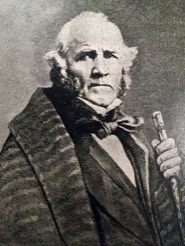
General Houston's last days were sad and unhappy. The wound which he had received at Tohopeka, fifty years before while fighting for the United States, and which had never entirely closed, began to trouble him afresh: The wound in the ankle, received at San Jacinto, had finally disabled him, and he who had once been so erect and strong, now went about feebly upon a crutch and cane. Added to these troubles, he saw his country going to ruin and he was powerless to aid her. He was very poor, and at times his family suffered for lack of the common necessaries of life. "He was sick of time and desired rest."
General Houston died at his home in Huntsville, Texas. July 26, 1863, aged seventy years. His last words were "Texas! Texas!" and "Margaret!" the name of his wife. A simple marble slab in the cemetery at Huntsville marks his last resting place. On it one may read this inscription: General Sam Houston, born March 2, 1793, died July 26,1863.
==========