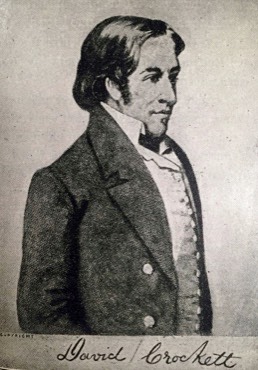
DAVID CROCKETT
In the "Life of Sam Houston" you were told of the brave men who died in the Alamo, fighting for the freedom of Texas. One of these men was David Crockett.
David Crockett was born in Tennessee on the 17th of August, 1786. He had five brothers and three sisters. His father was very poor and the family lived in the backwoods.
The house in which they lived was made of logs. The chinks between the logs were filled with clay. There were no windows in the house, and light and fresh air came in through the door or through the chinks in the wall. Small holes were made in the walls through which guns might be put to shoot at the Indians.
The country was full of Indians at that time. They were very troublesome. They would hide themselves near the settler's cabin and shoot down anyone who came out of the door. Often they would attack the house, break down the door, and kill the entire family. Crockett's grandfather and grandmother were both killed by them.
When David was seven or eight years old, his father gave up the farm and opened a mill for grinding corn into meal. The mill house was built on the banks of a small stream. One night there came a great rain storm. The water in the stream rose very high and washed away the mill house. It came up into the house in which Mr. Crockett lived, and he had to take his family out to keep them from being drowned. He then moved to another part of the country and opened a tavern.
David, being next to the oldest son, was a great help to his father and mother. When travelers would stop at the tavern for the night, David would help them to unhitch and feed their teams.
One night an old Dutchman by the name of Jacob Siler stopped at the tavern. He was taking to Virginia a large stock of cattle. He wanted some one to help him with his cattle. He liked David's bright face and business-like manner, and asked Mr. Crockett to hire him. David was now about twelve years old. He loved his father and mother dearly, and hated very much to leave home. But the family was very poor and he must help make the living.
With a heavy heart he set out on the journey. It was four hundred miles to the place he was going and he had to travel on foot. He got very tired and often wished to be back at home with his dear father and mother. But he felt it his duty to go on. His Dutch master was pleased with him and at the end of the journey gave him five or six dollars as his wages. It was a small sum, but David was very proud of it. It was the first money he had ever earned. He wanted to go home and take the money to his father. But his master did not want him to go and kept a strict watch over him.
One day he and two other boys were playing by the roadside, some distance from the house, when-three wag ons came along. They belonged to an old man who was going to Tennessee, and who knew David's father. David begged the old man to take him home. The old man said he would stay that night at a tavern seven miles away, and if David could get there before day the next morning he would take him home. This was Sunday evening. David went back to his master's house and found the family were out on a visit. He gathered his clothes and his money and put them all together under the head of his bed. He went to bed early that night, but he could not sleep. He kept thinking and thinking about his father and mother. And then, too, what if his master should find out that he was going home?
About three hours before day he got up to make his start. The night was dark and cold. It was snowing fast, and the snow was then on the ground about eight inches deep. When he got to the wagons, about an hour before day, it was up to his knees.
The men were already up and getting ready to start. The old man treated him with great kindness. David warmed himself by the fire and ate a hearty breakfast, after which the party set out on their journey.
How slowly the wheels turned! To David they seemed almost to stop. It seemed to him that he would never get home. He thought he could go faster by walking, so telling his old friend good-bye he set out on foot. He walked on until he was overtaken by a man leading a horse, who offered to let him ride. He was very glad of this chance, as he was very tired. This kind man took him within fifteen miles of his father's house, when they parted and David walked home.
Up to this time David had never been to school a day. He could neither read nor write. Near his father's house was a little country school, kept by a man named Kitchen. To this school his father now sent him. He had gone but four days and had just begun to learn his letters, when a dispute with a boy much larger and older than himself caused him to quit school.
He did not go to school again until he was fifteen years old. Then he began to think that all his troubles were caused by his want of learning, and that he had better enter school again. By working two days a week he got one of his neighbors to board him, and went to school the Other four days of the week. He kept this up for six months. In this time he had learn to read a little, to write his own name, and to cipher some. This was all the schooling he ever had.
David was very fond of shooting, and, as soon as he got money enough, he bought himself a good rifle. He carried it with him wherever he went. He often went to shooting matches, where they shot for beef. He was such a good shot that he often won the whole beef.
When he grew to be a man, he became a great hunter. The country where he lived was full of deer, bears, and other wild animals. Whenever his family wanted meat, he would go out into the woods and shoot a deer or a bear.
Here is a story he tells of one of his bear hunts: "In the morning I left my son at the camp, and we started to wards the canebrake. When we had gone about a mile, we started a very large bear, but we had to go very slowly, as the earth was full of cracks caused by earthquakes, and there was much danger of failing into them. We kept in hearing of the dogs, though, for about three miles, when we came to the canebrake.
"By this time several of the dogs had got tired and come back. We went ahead for some little time into the canebrake, until we met the bear coming straight to us, and not more than twenty yards off. I started my dogs after him, and I followed to about the middle of the cane brake. Here I found the bear in an old stump of a tree about twenty feet high, with the dogs barking all around him. When I got close enough to shoot, I fired, and the bear fell. I ran up to him, but he was not dead. I loaded my. gun as- quickly as I could, shot him again and killed him. When we had skinned the bear, we cut off the fat, packed it on our horses and started back to camp. We had gone but a little way when I heard my dogs barking again. I jumped down from my horse and gave him to my friend. He went on to camp, and I followed the dogs with all my might.
"Soon night came on. The woods were rough and hilly and all covered over with cane. I had to move very slowly. Several times I fell over logs and into cracks made by the earthquakes. I was very much afraid I would break my gun. I went on about three miles till I came to a big creek, which I waded. The water was about knee-deep and very cold. It was now so very dark that I could hardly see my way. When I got to the dogs, I found they had treed a bear in a large forked tree.
" I could see the dark hump in the tree, but not well enough to shoot. I hunted for some dry brush to make a light, but could find none. At last I thought I could shoot by guess and kill him. I pointed as near the hump as I could and fired. The bear did not fall, but climbed higher and got out on a limb, where I could see him better. I loaded again and fired, but he didn't move at all. I was loading for a third shot, when, the first thing I knew, the bear was down among the dogs, and they were fighting all around me. At last the bear got into one of the cracks made by the earthquake. I could not see a wink. I pushed my gun against him and fired. With that he jumped out of the crack, and he and the dogs had another hard fight around me. At last the dogs forced him back into the crack again.
"I had laid down my gun in the dark, and I now began to hunt for it. I got hold of a pole, and I thought I would punch the bear awhile with that. When I punched him, the dogs would jump in on him, and he would bite them and make them jump out again. While the dogs kept his head toward them, I got down into the crack and killed him with a long knife I carried in my belt.
"I suffered very much with cold that night. My clothes were wet and frozen. My fire was very bad, and I could not find anything that would burn well to make it any better. I thought I should freeze if I didn't warm myself in some way by exercise. I got up and shouted awhile with all my might. Then I would jump up and down and throw myself into all sorts of motions. But this would not do. My blood was getting cold and the chills were coming all over me. I was so tired, too, that I could hardly walk. But I thought I would do the best I could to save my life. I went to a tree about two feet through and not a limb on it for thirty feet, and I would climb up to the limbs, then lock my Arms around it and slide down to the bottom again. I kept on doing this till daylight. In the morning I hung my bear up, so as to be safe, and set out to hunt for my camp. I found it in a short while. My son and my friend were rejoiced to see me, as they had given me up for lost."
Crockett was a great Indian fighter, as well as bear hunter. He was in many battles with the Indians and was a brave1 soldier. Finally he came to be called Colonel Crockett.
Colonel Crockett was much liked by his neighbors wherever he lived. He was kind-hearted; he was full of fun; he was pleasant to every one he met; he was honest. In all things he tried to do what was right. His motto was, "Be sure you are right, then go ahead."
The people wanted a man of this kind to help make the laws, and they chose Colonel Crockett. They sent him first to the legislature of the State, and then to Congress. He stayed in Congress several years. When his time was out, he determined to go to Texas and help her against the Mexicans. Texas was fighting for freedom and needed soldiers very much. So bidding farewell to home and friends, he set out for that strange land.
On the way he was joined by two companions. One day they were riding through the prairies when they heard a low rumbling noise like thunder. They, stopped and listened. Nearer and louder grew the noise. They looked in the direction from which the sound came and saw a great cloud of dust rising over the prairie. They thought it. must be a storm coming. The noise grew louder and louder. The cloud of dust became thicker and thicker. Thinking that it might be a band of Indians coming, they rode into a grove of trees near by. They had just got under the trees when a great herd of buffaloes came dashing by as swift as the wind. If the colonel and his friends had not ridden under the trees, they would have been trampled to death.
Colonel Crockett had long wanted a chance to hunt buffaloes, and now here it was. He watched the herd for a few moments, then put spurs to his horse and followed them, leaving his friends behind him. He rode on as fast as his horse could carry him. But he could not keep up with the buffaloes, which were soon lost to sight in the distance.
He now stopped to let his horse breathe and to think how he should get back to his friends and the road he had left. He looked around him on every side, but nothing was to be seen but the broad prairie. Not even an animal was in sight.- Not a sound was to be heard. He was lost on the prairie.
Night came on and he began to look for a place of shelter. He found a large tree that had blown down and he thought he would sleep in its top. As he was climbing up among the branches, he heard a low growl. Looking up to see what sort of a bed-fellow he was to have, he saw, not more than five or six steps away, a great Mexican lion. With flashing eyes and grinning teeth he was just ready to spring upon the colonel. Crockett raised his rifle to his shoulder as quickly as he could and fired. The ball struck the lion on the forehead, but did not hurt him much. The next moment he sprang and lighted on the ground close by Crockett, who struck him over the head with the barrel of his rifle; but the lion didn't mind that at all. Crockett now threw down his gun and drew his large hunting knife. The lion came at him again and seized him by the shoulder. Crockett's foot tripped in a vine and he fell to the ground with the lion on top of him. Crockett thought his last hour had come. His arm and leg were badly torn. He felt himself getting very weak. Gathering all his strength for a last blow, he struck the lion with all his might in the neck. The lion let go his hold and in another moment rolled over on his side dead.
Crockett now went back to the tree to make his bed. He threw some moss on the ground, and over it spread his horse blanket. On this bed he lay down and, being very tired, soon fell fast asleep. He awoke at daybreak next morning. He was sore and stiff from his fight with the lion. He went for his horse, but it had run away during the night. What should he do, away off in this wild country, afoot and alone?
While he was thinking, a band of Indians rode up and surrounded him. They were friendly to the white men. The chief gave Crockett another horse and promised to take him back to his friends. The camp was reached that evening, when Crockett bade farewell to his kind friends, the Indians, and they rode away.
Crockett's companions were delighted to see him. The next day they reached the Alamo.
The Alamo is an old church in the city of San Antonio. The Texans had taken the town from the Mexicans some time before and had turned the old church into a fort, Colonel William B. Travis, with one hundred and eighty soldiers, held the fort for the Texans. Colonel Travis was glad to see Crockett and his companions and welcomed them to the fort.
Not many days after Crockett's arrival news came that the Mexican general, Santa Anna, with a large army, was coming to take the fort. The Texans made ready to receive them. They stored their arms and provisions in the fort and raised the Texas flag.
The Mexicans marched into the city with a blood-red, flag flying. This red flag meant that all who were taken prisoners would be put to death. They sent a messenger to Colonel Travis, asking him to surrender and declaring that if he did not surrender every man would be put to death. Colonel Travis' answer was a cannon shot.
Colonel Travis now sent word to General Houston that he was surrounded by the Mexicans and asked for help. In his letter he said, "I shall never surrender or retreat! Victory or death! "
But no help came. The Mexicans drew nearer and nearer to the fort. On the 6th of March, 1836, before daybreak, they closed about the walls of the fort. They brought ladders with them and tried to climb over the walls. But the Texans poured upon them a terrible hail of shot and shell and kept them back. A second time they went up the ladders, but with no better success. A third time they swarmed up the ladders, driven by the swords of their officers. This time they went over the walls amongst the Texans. The Texans "fought like brave men — long and well." They sold their lives as dearly as possible. When daylight came, only six of them were found alive. Among this number was Colonel Crockett. He stood alone in a corner of the fort, the barrel of his shattered rifle in his right hand and his huge bowie knife in his left. There was a great gash across his forehead. Twenty or thirty of his foes lay dead at his feet.
Crockett with the other five Texans were taken prisoners and carried before General Santa Anna, who ordered them to be put to death at once.
When Crockett heard this order, he sprang like a tiger at Santa Anna, but before he could reach him a dozen swords pierced his heart and he fell and died without a groan.
==========