THE ALAMO
When La Salle landed at Matagorda Bay, the whole country was claimed by the Spaniards. No other white people were allowed to come into the country, or even to enter the Gulf of Mexico, on pain of death.
When the Spaniards heard that La Salle had landed, they sent a company of soldiers to find him and destroy his colony. But not a Frenchman was to be found at La Salle's little fort. Not many days after La Salle had left on his last sad journey, the fort was attacked by Indians and most of the people were put to death. Their bleaching bones were found by the Spaniards scattered over the prairie. Some few escaped to the wigwams of friendly Indians where they were found by the Spaniards and sent back to their homes in France. The fort was in ruins. A house with the figures "1685" over the door and the remains of the vessel wrecked in crossing the bar were all that was left.
To keep out other strangers and to control the Indians, the Spaniards decided to build a line of forts or missions across the country. These missions often covered many acres of ground, and were surrounded by high thick walls of solid rock. Soldiers were kept in them to fight in case of need, and there were priests to teach the Indians how to become Christians. Inside the walls there were houses for the priests and soldiers, storehouses, prisons and a church. Outside the walls were huts for the converted Indians.
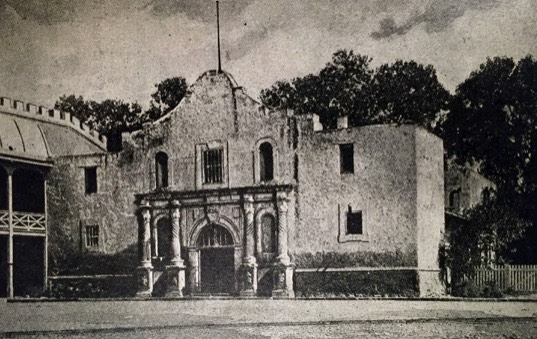
One of the most interesting of these missions is the Alamo. It is in the city of San Antonio and was built in 1744. Alamo, in Spanish, means poplar tree, and the mission was so named because it was built in a grove of poplars.
It was in the old church of the Alamo that Colonel William B. Travis and a handful of brave men, one hundred and eighty all told, laid down their lives for the cause of Texas.
Texas at this time belonged to Mexico. The Texans wanted to live in peace and be treated as all good citizens of a country, should be. But they loved liberty even more than peace, and would fight for it to their last breath. The president of Mexico was General Santa Anna, a cruel, hard-hearted man, who hated liberty-loving people. He wanted every knee to bow to him and every tongue to call him master. As the Texans would not do this, he determined to make them.
He gathered a large army and marched against San Antonio. Colonel Travis, was holding the city for the Texans. Only a few months before, it had been captured from the Mexican General Cos, by "Old Ben Milam" and Colonel Francis W. Johnson. General Cos, who was a brother-in-law of Santa Anna, was taken prisoner.
Travis thought Santa Anna would seek revenge, so a sharp lookout was kept for him. A soldier was placed in the tower of the old church of San Fernando to give the alarm should the Mexicans appear. He had not long to watch. At sunrise on February 22, 1836, he saw the soldiers of Santa Anna pouring over the hills to the west pf. the city. On they came by hundreds and thousands, led by General Santa Anna himself, on a beautiful milk-white horse. At their head a blood-red flag was flying, which meant death to every Texan who should fall into their hands. Loud and shrill over the roofs of the still sleeping town rang the sentinel's cry of alarm. Soon the streets were crowded with people, men, women and children, all flying from the dreaded enemy.
Travis quickly got his men together and marched into .the Alamo. He thought he could fight better and hold out longer behind its strong walls. Scarcely were the gates closed when the Mexicans marched into the town.
In the afternoon Santa Anna sent a messenger to Colonel Travis demanding a surrender. But the only answer he received from that brave leader was a cannon shot.
Travis had only eight cannon, and very little powder and shot. Food also was very scarce In the whole fort there were only three bushels of corn, But brave hearts were there. There was David Crockett, the fearless Tennessee bear hunter, with his deadly rifle; J. B. Bonham, a gallant son of South Carolina; James Bowie, the well- beloved friend ofTravis; Colonel John N. Seguin, a noble-hearted Mexican who hated the cruelty of Santa Anna, and others whose names should never be forgotten by the people of Texas.
Each day the enemy drew nearer and nearer. From every direction they poured showers of cannon balls into the fort.
Travis now sent out messengers asking for help. He wrote: "We are completely surrounded by the enemy. For God's sake arid the sake of our country, send us help. We are determined to hold the Alamo to the last. I shall never surrender or retreat! Victory or death! "
To a friend he wrote: "Take care of my little boy. If the country is saved, I may be able to make him a for tune. But if all is lost and I shall perish, I will leave him nothing but the proud recollection that he is the son of a man who died for his country."
One of the messengers sent out was Colonel Bonham. He was sent to Goliad to ask help of Colonel Fannin. He delivered the message and with the answer started back to San Antonio. His friends tried to persuade him not to return. They told him the Mexicans would be sure to take the Alamo and he would lose his life. "It does not matter," he replied, "I will make my report to Travis or die in the attempt." "Mounted on a cream-colored horse, with a white handkerchief floating from his hat, he dashed through the Mexican lines amid a shower of bullets and entered the fort unharmed. Unable to save his comrades, he was determined to die with them."
Dr. Sutherland and John W. Smith were sent to Gonzales. When their story was told, Colonel Albert Martin and thirty-two brave men of that town at once made ready to return with them to the Alamo. On March 1st they passed the Mexican lines and entered the fort.
On March 6th, the last day of the siege, Sutherland and Smith were again sent out for help. Just outside the city they were seen by the Mexican sentinels, who began firing on them. Dr. Sutherland's horse was shot and fell upon him, breaking his leg. Smith would not leave his friend to be killed. His own horse was ready to drop, but he drew the doctor up behind him and made off as fast as the tired animal could carry them. After many weary, painful miles, they reached a farm where the wounded man was cared for. Smith dressed the wound and then went on to look for help. But it was too late. Nearer and nearer to the fort came the Mexicans. Travis and his little band often sallied out and drove them back, but in a short while they came on again, and nearer than before.
Early one morning, a party of the enemy planted a cannon close to the fort and began firing. A ball struck the wall near where Colonel Crockett was sleeping. He sprang up and ran out on the roof. He saw a gunner with a lighted match in his hand just ready to fire another shot. Crockett raised his rifle to his shoulder and fired. The gunner fell dead. Another Mexican snatched the match and was preparing to touch off the cannon when he was stretched on the earth beside the first. A third, a fourth and a fifth seized the match, but all met the same fate. Others were afraid to expose themselves, so they stopped firing and hurried off to camp, leaving the cannon ready charged where they had planted it.
For ten days this little band of heroes defended their fort, until they were completely worn out with watching and fighting. They could hardly keep awake while firing. Travis knew that the fort could not hold out much longer, so he called his men together and made them a short talk. He told them that there was no longer any hope that help would come; that death was staring them all in the face; that anyone who wished might leave the fort. For himself, he meant to stay and die fighting for his country. He then drew a line on the ground with the point of his sword, and told all who were willing to stay with him to come across the line. Scarcely were the words out of his mouth when all the men, all save one, with a yell sprang over the line. Tapley Holland was the first. He leaped across shouting, "I am ready to die for my country." Every sick man who could walk arose and tottered across the line. Bowie, who was too sick to walk, called to them not to leave him, and he was lifted over in his cot.
On Sunday morning, March 6th, the whole Mexican army, six thousand strong, surrounded the Alamo. Santa Anna had made up his mind to capture the place, cost what it might. He divided his troops into four columns, and put horsemen behind them to prick them on if they should wish to turn back.
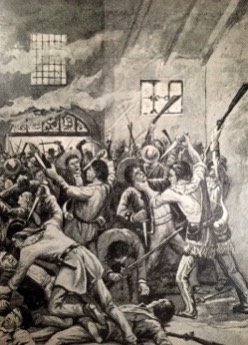
The troops carried ladders, to climb upon the walls, and axes and crowbars to batter them down. Soon after midnight the bugles sounded, and the whole line moved at a double quick upon the fort. But the Texans were ready for them, and poured upon them such a deadly shower of musket and rifle balls that they were obliged to fall back. Just at daylight ladders were placed against the walls, and soldiers by thousands began to climb up. But they went to their death. The rifles of the Texans mowed them down like grass. The ladders were toppled over, and the Mexicans were forced to retreat. Again the bugles sounded the charge; again a rush was made for the walls, and this time, spurred on by their officers from behind, the Mexican soldiers mounted the walls and tumbled over like sheep.
Then began the last struggle. The Texans clubbed their guns when there was no longer time to load, and with shouts and yells fought from room to room. But there was no way of escape, even if one had been wanted. Mexicans were swarming on all sides.
Colonel Travis, while standing on the wall cheering on his men, was shot and fell dying into the fort. In a little while he recovered enough to sit up, when a Mexican officer rushed forward to kill him. Gathering all his strength for a last blow, Travis met the Mexican with a thrust of his sword, and both died together.
Bowie was. still sick in bed. When the Mexicans appeared at the door of his room, he raised himself on his elbow and fired his pistols and gun at them. Each shot brought down a man. He then drew a huge knife that was lying beside him on the bed, and waited the approach of the enemy. But they dared not go near him, and shot him from the door.
With Major Dickinson in the Alamo were his wife and children, one a baby girl only a few months old. They had come to pay him a visit and before they could get away the Mexicans had surrounded the place. The father's heart was in great fear for the safety of his little ones. When he saw that all was lost, he tied his baby to his back, and leaped from one of the upper windows. But it was a leap to death. Father and child fell to the ground riddled with bullets.
Crockett and several others were driven to a corner of the church where, with backs to the wall, they fought with the fury of tigers. Their faces were begrimed with powder, and blood trickled from many wounds. Crockett had a frightful gash across his forehead. Piles of Mexicans, dead and dying, lay around them.
When they could fight no longer, Crockett and five others were taken prisoners, and carried before General Santa Anna.
General Castrollon, who captured them, was a brave man, and he loved bravery in others. He wanted to save their lives. He said to General Santa Anna, "Sire, here are six prisoners; what shall I do with them? "
"Did I not tell you that no prisoners were to be taken?" shouted Santa Anna in rage. "To death with them."
This cruel order was immediately carried out. The last Texan had fallen, and with him the Alamo.
Upon the cenotaph erected at Austin, in memory of the defenders of the Alamo, is the following expressive and worthy tribute: "Thermopylae had its messenger of defeat, but the Alamo had none."
==========