REMEMBER GOLIAD!
When Colonel Bonham returned to the Alamo, he carried with him Colonel Fannin's promise of help. This was glad news to the little band in the Alamo, but, as we have seen, the help never came.
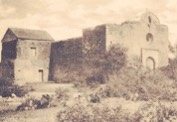
Three days after Bonham left Goliad, Fannin was on the way to the Alamo with three hundred men and four cannon. The cannon were on wagons drawn by oxen. There was only one yoke to each wagon. In crossing the San Antonio River, which runs through Goliad, the teams had to be doubled in order to get the cannon over, one at a time. Scarcely were they across the river, when the wagons broke down and a halt was made to mend them.
While making this stop, Fannin learned that a large Mexican force had been sent to meet him and cut him off from San Antonio.
Ox teams travel very slowly. San Antonio was a hundred miles away. Provisions were scarce. In the whole camp there were only a few pounds of lice and a little dried beef. The Alamo was surrounded by an army of six thousand men, and reinforcements were constantly coming up. What could three hundred do against such a force?
After talking over these matters with his men, Fannin thought it best to return to Goliad and prepare for the enemy. There was an old mission here and into this Fannin marched his troops. He strengthened the walls of the mission, dug ditches about it, and mounted cannon, already charged, upon the earthworks and waited the coming of the enemy.
But now word came that some Texan families at Refugio were in danger and begging for help. Fannin sent Captain King with twenty-eight men to their assistance and to bring them away. When King arrived at Refugio, he was met by a large Mexican force that drove him into the old mission at that place. From here he fought the Mexicans off until he could send to Fannin for more help. On hearing this news, Fannin sent Colonel Ward with one hundred men to King's relief. For several days no word came from Ward or King. Fearing for their safety, Fannin sent out a messenger to seek news of them. This messenger did not return. A second was sent and a third, but none of them returned. All three fell into the hands of the Mexicans and were put to death.
As his messengers did not return, Fannin became un easy and anxious about his own little army. With Ward and King he had sent away a hundred and thirty of his best men. He had now with him only three hundred men, and the enemy force was reported as having six times that number. Reinforcements soon came to Fannin, but not enough to add much strength to his small force. Believing that he would not be able to hold out against such odds, and knowing the fate that would meet him and his men should they be captured, he made up his mind to retreat.
On the morning of the eighteenth of March, a small body of the enemy appeared before the fort and shots were exchanged. Early on the morning of the 19th the retreat commenced. A dense fog covered everything. Like a great white curtain it shut off the view of the country around. The baggage and cannon were placed on wagons drawn by oxen, the earthworks were torn down, and, under cover of the friendly fog, the little army marched out of the town. When the river was reached, a portion of the cannon were thrown into it as the oxen were too weak to draw them. Scouts were sent to the front and rear to keep a lookout for the enemy.
Nine miles from Goliad a stop was made to rest and graze the oxen. The scouts reported no enemy in sight anywhere, and Colonel Fannin began to hope that he would not be followed. After an hour's rest the line of march was again taken up. But slow progress was made. The wagons were heavy, and the oxen were weakened from lack of food.
They had gone about two miles when a company of the enemy's cavalry was seen coming from the timber that bordered the Coleta creek, about a mile away. The Texans halted and fired several shots from their cannon, but they all fell short. The scouts in the rear, unmindful of their duty, had lain down to rest. The firing started them to their feet. Finding themselves almost surrounded by the Mexican cavalry, they sprang on their horses and sped like the wind toward the main body of the Texans.
Other bodies of the enemy were now seen coming from the woods in different places. Fannin hurried up his teams to get to the timber in front of him, but one of his ammunition wagons broke down and he had to stop on the open prairie in a kind of hollow, and get ready for battle.
Fannin formed his men in a hollow square, facing outwards. The wagons and teams were placed in the center of the square. The cannon were placed in position and the battle commenced.
In front and rear the Mexicans moved down upon the little army of Texans. Their cavalry galloped up in dashing style, but were sent reeling back to the woods by a discharge of Fannin's artillery. The infantry, 1,200 strong, now came down upon the rear, firing as-they came. The Texans sat down upon the grass and with rifles to the shoulder and fingers on the trigger waited for their approach. On they came, and there seamed to be no hope for the little band of Texans. But suddenly there was a deafening roar. A sheet of flame leapt from the ranks of the Texans and hundreds of death-dealing balls from rifle and musket and cannon went tearing through the enemy's lines.
The Mexicans fell by scores. Those that were not killed lay down in the grass to escape the dreadful hail of bullets. Now and then a soldier would raise himself above the grass to shoot; but whenever a head appeared, the rifles of the Texans spoke with deadly certainty. And now the cavalry charged again, to be driven from the field a second time.
The fight kept up from one o'clock in the afternoon till sundown. Then the Mexicans drew off, leaving the Texans surrounded by patrols. During the day the Texans had seven men killed and sixty wounded. Colonel Fannin was among the wounded. The Mexicans lost nearly five times as many.
The Texans spent the night building breastworks, for they knew that with the morning sun the enemy would be down upon them again. Great piles of earth were thrown up. The carts and wagons were taken from the center of the square, and piled around the edges. All of that terrible afternoon and night the men were without water. Neither was there any food to be had. Their provisions had all been left at Goliad. Parched with thirst, weak from want of food, and worn out with toil, they saw the day break over the prairie.
Fannin expected help to come during the night, but none came.. The Mexicans, however, were reinforced by five hundred fresh troops with artillery.
When Fannin saw the artillery his heart sank within him. His breastworks had been thrown up as a defense against rifles and muskets. But they were of no use against artillery. One discharge would tear them to pieces. His own cannon were useless, as he had no water to sponge them with, and they soon became too hot to handle. What should he do? The wounded men, with pitiful cries, begged him to surrender so that they might get water.
While Fannin and his officers were talking the matter over, Mrs. Cash, a woman who had come with the Texans from Goliad, said she would go over to the Mexican lines and get water for the wounded. Her little son, a boy of fourteen, went with her. The boy had been in the thickest of the fight the day before, and still wore his shot-pouch and powder-horn. When they got to the Mexican lines, Mrs. Cash made known her errand. The Mexican general paid no attention to her request, but fixing his eyes on the boy, said: "Woman, are you not ashamed to bring one of such tender years into such a situation?" Quick as a flash the boy made answer, "Young as I am I know my rights, as does every Texan, and we intend to have them or die."
At that moment a white flag was raised over the Texan camp. This meant surrender. Some of the men thought it would be best to fight to the last and die with arms in their hands like the brave defenders of the Alamo. But with the cries of the wounded and dying ringing in their, ears, begging for water, what else could they do but surrender!
The Mexican general promised Colonel Fannin that he and his men should be well treated, and in eight days sent back to their homes. With this promise the Texans immediately stacked their arms.
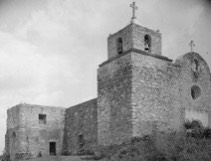
On the same day all who were able to march were taken back to Goliad and placed in the old mission church, which they had left the day before. This was the 20th of March. A few days later Colonel Fannin and the other wounded were brought in, and also Colonel Ward and his men who had been captured at Refugio. This crowded the church very much. There was hardly room for the men to lie down at night. Besides this they were ill fed and badly treated in other ways.
But the Texans gave little thought to these disagreeable matters. Thoughts of home filled their minds. Were they not to be released in eight days? How glad mother would be to see her boy again! How delighted the children would be at father's return! Sister would be so happy to see brother well and safe home once more. It was Saturday night, the sixth day after the surrender. The morrow would bring freedom. Scarcely an eye was closed in sleep. Far into the night the soldiers sang "Home, Sweet Home."
At sunrise the next morning a Mexican officer came into the fort, and told the men to get ready for a march, that they were to be liberated and sent back to their homes. This was joyful news indeed, and it was not long before every man stood ready to march. They were formed into three companies and marched out of the gates under a strong guard. "Poor fellows!" said some Mexican women who were standing by the gate.
Each company was marched in a different direction. When nearly a mile from the fort they were halted and told to kneel. "They're going to shoot us, boys," cried some one, and the clicking of the muskets all along the Mexican lines told that it was true. "Let us die like men," shouted some one. "Hurrah for Texas!" cried others as the fatal bullets came whizzing through their ranks. Once, twice, three times the guns rang out on the still morning air. And at every discharge scores of the Texans fell dead and dying. Some who were not dead fell and pretended death; others fled toward the river, closely followed by the Mexicans.
One who was there says: "The man in front of me was shot dead, and in falling knocked me down. I did not get up for a moment, but when I rose to my feet I found that the whole Mexican line had charged over me and were in hot pursuit of those who had not been shot and who were fleeing to the river, about five hundred yards distant. I followed on after them. I knew I could not escape in any other direction, as the country around was all open prairie. I had nearly reached the river when I had to make my way through the Mexican line ahead. As I did so, a soldier charged me with his bayonet. As he drew back his musket to make a lunge at me, one of our men, coming from another direction, ran between us and the bayonet was driven through his body. I was some what in a hurry just then, and I hastened to the bank of the river and plunged in. The river was deep and swift, but not wide, and, being a good swimmer, I soon gained the opposite bank, untouched by any of the bullets that were pattering in the water around my head."
Twenty-eight of the Texans escaped by running through the guards. Through the kindness of a Mexican officer, twenty-nine others were saved.
The wounded were next dragged from their beds in the hospital and shot. Colonel Fannin was the last to die. When told to prepare for death, he said he was ready at that moment and had no wish to live after seeing his men so cruelly murdered. He was taken by a guard out to the square, where he was seated on a bench and blindfolded. He gave his watch and what money he had to an officer to be sent to his wife. As a last favor he asked to be shot in the breast and not in the head, and that his body be decently buried. The officer took the watch and the money and ordered the guard to fire at his head. His body was stripped of its clothing and cast into a ravine.
The bodies of the dead Texans, three hundred and fifty in all, were thrown into heaps and partly burned. Some months afterwards the bones were collected in front of the fort and buried by the Texan General Rusk. No monument marks the spot where they lie buried. So long as time shall be, the story of their noble deeds will be told, and their memory will ever be kept green in the hearts of their countrymen.
Chapter 9 - The Story of San Jacinto
==========