THE STORY OF SAN JACINTO
General Santa Anna was very much puffed up over his victories at the Alamo and Goliad. He called himself the Napoleon of the West. He thought the Texans were conquered and that they would not dare to oppose him again. But he was mistaken. He did not yet know of what stuff the Texans were made.
He divided his army into three parts and ordered his generals to sweep over the country and drive all the people across the Sabine River. The Sabine was then the boundary line between Mexico and the United States. He further ordered that all prisoners found in arms against Mexico should be shot.
On the 11th day of March, five days after the fall of the Alamo, General Houston arrived at Gonzales. He had been appointed general of the Texan army, and was on his way to the Alamo to aid Travis. That night he heard of the terrible fate of Travis and his men. He also learned of the advance of Santa Anna with one division of his army, numbering four thousand men.
The people were wild with excitement. Families left their homes and fled for their lives. "On every road leading eastward in Texas were found men, women and children moving through the country, over swollen streams and muddy roads, strewing the way with their property, crying for aid, and exposed to the fierce northers and rains of spring."
Houston gathered about him at Gonzales a little army of less than four hundred men and determined to do all in his power to prevent the advance of the enemy. He was short of provisions. Many of his men were without arms, and others had no ammunition. But one and all were anxious to fight. They longed for the day to come when they could avenge the death of the brave men of the Alamo.
Houston knew it would be madness for a handful of half-armed men, such as his were, to fight the well-armed thousands of Santa Anna. He thought it best to retreat, and on the 13th of March he began to fall back. Four days later he reached the Colorado River. By this time his force had increased to over six hundred men. He remained here till the 26th of March, waiting for more men and artillery. He then fell back upon the Brazos, where he camped on the first day of April.
The spring rains had set in and the river was out of its banks. The camps were pitched in the midst of trees, mud and water. The soldiers had few tents or coverings, and they suffered much. General Houston spent the night sitting on his saddle, with a blanket around him, and his feet on a piece of wood.
Here Houston heard the news of the sad fate of Fannin and his men. The hope of Texas now rested in his army. Should he make a false step all would be lost. This thought caused him much anxiety. To a friend he wrote: "Since we parted I have found the darkest hours of my life. For forty-eight hours I have neither eaten an ounce of anything, nor have I slept."
He sent out letters begging the people to come to his assistance. He wrote: "Let the Mexican force be what it may, if the country will turn out we can beat them. Send agents to the United States. Appeal to them in the holy names of Liberty and Humanity. Let the men from the east of the Trinity rush to us. If only three hundred men remain with me, I will die with them or conquer our enemy."
Houston kept his army in the river bottom till April 12. On that day Santa Anna reached the Brazos lower down and crossed over. Step by step he had followed the retreating Texans and he now thought they were safely entrapped.
With this thought in his mind Santa Anna left the main body of his army and with seven hundred men and one cannon marched to Harrisburg to capture the Texan president. He sent word to Houston that when he had captured the president he would come back and smoke him out.
Santa Anna reached Harrisburg on the 15th of April, but found the town deserted. The people had left their homes and fled for their lives. They had no desire to make the acquaintance of the "Prince of Butchers," as Santa Anna was called.
Burning the town, he followed on after President Burnet. The president had brought his family, to New Washington, at the head of Galveston Bay, intending to send them to Galveston for safety. On the morning of the 17th, while making ready to go on board the boat that was to take them to Galveston, the Mexican cavalry came suddenly upon them. They hastily got into a small boat and rowed out some distance from the shore, thus making their escape.
When Houston received the news that Santa Anna had crossed the Brazos, he made up his mind to follow him and not wait to be "smoked out." From being hunted, Houston now turned hunter. Santa Anna's army was scattered. It was in the enemy's country and far from its supplies. Defeat here meant ruin.
This was just as Houston would have it. He crossed the river without delay and headed his army for Harrisburg. On the farther shore he found two small cannon, a gift to the Texans from the people of Cincinnati. The two little guns were called the "Twin Sisters," and Houston was very proud of them.
The march was a very difficult one. Heavy rains had fallen and the prairies were boggy. In many places the wagons had to be unloaded and the cannon carried or rolled through the mire.
On the 18th of April, the Texan army reached Buffalo Bayou near Harrisburg. The soldiers were almost worn out from their long, wearisome march, and General Houston ordered a halt for a day, to rest. Scouts were sent out into the country to get news of the enemy. About dark they came in, bringing two prisoners with them. From these prisoners it was learned that Harrisburg had been burned, and that Santa Anna was not far away down the bayou.
The hearts of the men "beat high in their breasts." They forgot that they were tired. Their one thought and wish was to be led against the butcher. General Houston felt just as the men did. He thought that now or never the blow must be struck that would make Texas free.
Early next morning (April 19th) the men were drawn up into line and told to prepare for marching. General Houston then made them a short talk. He told them he had made up his mind to cross the bayou and hunt up Santa Anna; that a great battle would perhaps be fought, in which many of them would lose their lives;, that any who did not wish to cross the bayou need not go. He told them that their battle cry should be, "Remember the Alamo!" "Remember Goliad!"
"Not a man able to walk but begged to cross the bayou. Every sick man wept at being left behind. Men had to be drafted to guard the camp and the sick."
This same morning General Houston wrote to a friend: "This morning we are in preparation to meet Santa Anna. It is the only chance of saving Texas. The troops are in fine spirits, and we go to conquer. The odds are greatly against us, but I leave the result in the hands of a wise God, and rely upon his providence."
When the army arrived at the bayou, they found the boat that was to take them over nearly filled with water. It was bailed out and the passage begun.
When about half the army was over, an accident happened to the boat which came near sending it to the bottom. It was quickly mended, and by nightfall all of the troops were safely over. The boat was not strong enough to carry the horses, and they "were made to swim the stream just below the ferry. "Thank God we are at last safely over," said General Houston.
Soon after dark the line of march was again taken up. All through the night the prairies echoed with the tramp, tramp, tramp of these soldiers of freedom. At the head of the columns rode their great chief, General Houston. His eyes were bent upon the ground, and his thoughts were busy planning for the battle which he knew must soon take place. The stars looked down as if in blessing and lent their kindly light to guide the footsteps of the avengers.
At one o'clock on the morning of April 20th a short halt was made to rest the men. Tired and hungry, they threw themselves on the bare ground and slept. For a pillow General Houston had a coil of rope which had been used in drawing the cannon.
At daylight Houston was awake and with three taps of a drum aroused his sleeping soldiers. With one accord the men sprang to their feet and stood ready for duty. Orders were given to continue the march down the bayou. Scouts were sent out in every direction to get news of the enemy.
After marching a short distance a halt was made for breakfast. The beeves had been killed and roasting fires kindled, when a scout came flying into camp with the news that Santa Anna was advancing up the bayou, and was not far away.
General Houston immediately ordered the men into line. Hungry as they were, not a man held back. The meat was left half cooked, the horses were quickly harnessed to the cannon and the march began.
Not many miles away the San Jacinto River joins Buffalo Bayou, and their waters fall together into Galveston Bay. It was to this place that the Texans were hastening. There was a ferry here over which Santa Anna hoped to cross into East Texas, and hither his army was hastening. Once across there would be nothing to oppose him. The whole of East Texas would be at his mercy.
Knowing this, Houston urged his men forward at their utmost speed. He must reach the ferry before Santa Anna. On, on, sped the Texans, never halting once till the ferry came in sight. Great was their joy when they learned that the Mexicans had not yet come up. Houston knew the hour had come that was to decide the fate of Texas. The battle was now to be fought that would give the people freedom or chains and slavery. The heart of the great leader throbbed with pain as he thought of a possible defeat. Poor Texas! What would become of her, then? Poor wives and mothers! Poor children! No; it should not be so. Justice and right would win. And were they not on the side of the brave Texans?
Houston pitched his camp near the bank of the river in a beautiful grove of trees, and waited the approach of the enemy. The troops were formed for battle and the "Twin Sisters" placed in position. In a short while the scouts came in with the news that the Mexicans were in sight, and the bugles of Santa Anna were heard over the prairie sounding the charge of the Mexican army.
The longed-for moment has come! There is the army of Santa Anna, the Butcher. There stand those Mexicans who stormed the Alamo and put to death Travis, Bowie, Crockett, Bonham and their immortal comrades! The hour of vengeance is at hand.
Santa Anna, thinking to surprise Houston, quickly got his cannon in position and began firing upon the Texans' camp. The firing was kept up for an hour, but it did little damage. One shot struck the bridle bit of Houston's horse, and another wounded Colonel Neill, the commander of the "Twin Sisters." A column of infantry was then sent forward. When within one hundred and fifty yards of the Texan lines, the "Twin Sisters" opened upon them and sent them flying back. The Texans gave a great shout at this, but did not follow the retreating enemy. Houston did not mean to fight till he was sure of victory.
This was about ten o'clock in the morning. In the afternoon, about an hour before sunset, another small fight occurred in which the Texans lost two men and several of their horses.
Both armies now retired to their quarters for the night. The camps were about three-quarters of a mile apart. Each army could see the other's camp fires glimmering over the prairie and hear the sentinels' tread as they paced to and fro on their beats.
The Mexicans spent most of the night in throwing up breastworks of trunks and baggage. The Texans, after eating a hearty meal, laid themselves down to rest. As the first gray lines of dawn shot up in the east, three strange taps of a drum were heard, and the seven hundred soldiers sprang to their feet as one man. A hasty breakfast was prepared and eaten. Guns and ammunition were made ready and the men lined up, awaiting the orders of their commander.
By this time the sun had risen bright and clear over the prairie. "Old Sol shows a smiling face; we'll have good luck today," said the soldiers. "The sun of victory has risen again," said General Houston, as he sprang from his bed on the bare ground. All eyes were now turned on the enemy's camp. All wondered what their next move would be. About nine o'clock a large body of men was seen advancing over the prairie. Was help coming at last? Yes; but for the enemy! The scouts brought word that it was Cos, the Oath-Breaker, with several hundred fresh Mexican troops.
Houston was greatly disturbed by this news. Should it reach the ears of his men it might discourage them, and the battle on which he had staked his hopes and the hopes of Texas would not be fought. At noon he called his officers together to consult with them as to what was best to be done. Some were for attacking the enemy at once; others were in favor of awaiting an attack from him. The soldiers were then asked for their opinion. To a man they answered "Fight."
It was three o'clock in the afternoon when Houston ordered the troops to parade. The men were in high spirits. Their officers could hardly restrain them from rushing headlong upon the enemy's camp. The moment had at last come. Houston ordered the charge and sounded the war-cry, "Remember the Alamo!" From rank to rank the magic words flew, and then, as if from one mighty throat, a cry went up that froze the blood of the Mexicans and chilled their hearts with terror.
At that moment a rider came up on a horse covered with mire and foam, swinging an ax over his head, and dashed along the Texan lines, crying, as he had been told to do, "I have cut down Vince's bridge — now "fight for your lives and remember the Alamo." This rider was Deaf Smith, the famous scout.
Vince's bridge was over Vince's Bayou, five miles from Harrisburg. Both armies had crossed this bridge on their downward march, and it was the only passway by land at this season of the year. Houston ordered it cut down so that the enemy would have no way of escape. His own men, too, would fight harder, knowing that there would be no way of escape for them should they be defeated. They must conquer or die.
The Mexicans were taking their siesta, or afternoon nap, when the war-cry of the Texans broke on their ears. They were quickly formed into line by their officers, but they were dull and heavy from sleep.
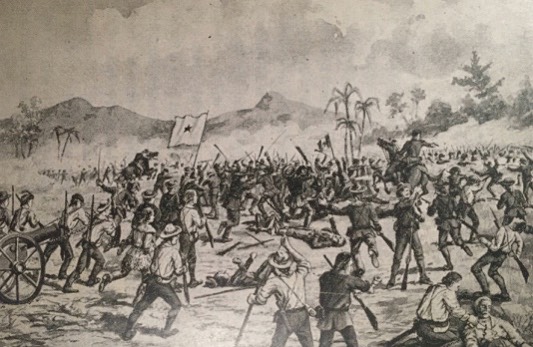
Down came the Texans upon them like an avalanche of fire, each man shouting like mad. Houston led the center column right into the face of the foe. Suddenly a flash of fire was seen along the Mexican lines and a storm of bullets went flying over the Texan army. Houston's horse was shot several times, and one ball shattered the General's ankle.
Before the Mexicans could reload, the Texans were upon them. Over the breastworks they went, right into the midst of the enemy. Right into the bosoms of the Mexicans they poured such a deadly shower of musket and rifle balls that the soldiers of Santa Anna turned and fled like hunted deer before the hounds.
Some fled towards the river, some towards a swamp in their rear, some towards Vince's bridge. But whichever way they turned, there were the avenging Texans. Many poor fellows, seeing escape impossible, kneeled to plead for mercy, crying, "Me no Alamo! Me no Alamo! "
A large number took refuge in a clump of trees near by, where they made haste to surrender. The pursuit of the flying enemy was kept up till dark, by which time most of them had been killed or taken prisoner.
The Mexicans lost six hundred and thirty killed, and two hundred and eight wounded. Seven hundred and thirty prisoners were taken. Only eight of the Texans were killed and twenty-five wounded.
When the Texans returned to camp, they gathered around their commander, and, slapping him on the unwounded leg, exclaimed: "Do you like our work today, General?" "Yes, boys," Houston replied, "you have covered yourselves with glory."
Just as the attack began, an old Texan was seen carrying two guns. He was asked why he carried more than one gun. He answered, "The Mexicans killed my son and son-in-law in the Alamo, and I intend to kill two of them for it." When seen later during the fight he said that he had killed his two men, and if he could find Santa Anna himself he would cut a razor-strop from his back.
When Santa Anna saw his flying columns come rushing by, he called a drummer and bade him beat his drum. The drummer held up his hands and shouted that he was shot. Santa Anna then called to a trumpeter standing near to sound his trumpet. The trumpeter replied that he was shot. Just then a ball from the "Twin Sisters," struck a man standing by Santa Anna, carrying away his head. "How those Americans shoot!" said Santa Anna. "I believe they will kill us all." Then mounting his horse he commenced his flight.
The morning after the battle Houston sent out men to scour the country around in search of any Mexicans that might have escaped. Santa Anna had hidden in a thicket all night. At dawn he crept out and lay down in the tall grass. Here he was found by the Texans. When he heard the scouts coming, he threw a blanket over his head and lay very still. He was dressed as a private soldier. His trousers were of coarse blue cotton and very much soiled. On his head he wore a soldier's skin-cap and on his feet a pair of red worsted slippers. A coarse blue jacket covered his shoulders.
The Texans called to him to get up, but he only uncovered his head and stared at them. Not until he was told two or three times did he rise. His fine manners made the Texans think he was more than a common soldier. It was also noticed that under his old clothes he wore a shirt of the finest linen, in the bosom of which were jeweled studs. He claimed that he could not walk, so he was mounted on a horse behind a soldier and taken at once to Houston's camp.
Houston was lying on a mattress under a great oak tree when the party with the prisoner rode up. The pain of his wound had kept him awake all night, and now he had fallen into a slight doze. The other Mexican prisoners on seeing the newcomer, broke out in a cry of surprise, "El Presidente!" Houston was awakened by the noise and looked up. As he did so, the prisoner, holding out his left arm and laying his right hand over his heart, said: "l am General Antonio Lopez de Santa Anna, President of the Mexican Republic, and I claim to be your prisoner of war." Thus did the proud "Napoleon of the West" humble himself before plain Mister Houston.
While Houston was talking to Santa Anna, he took from his pocket an ear of dry corn which he had carried for four days. Only a part of it had been eaten. He held it up and said to Santa Anna, "Sir, do you ever expect to conquer men who fight for freedom when their general can march for four days with nothing to eat but one ear of corn?"
Houston's soldiers gathered around him and asked him to let them divide the corn. "We will plant it," they said, "and call it Houston corn."
"Oh, yes; my brave fellows," said the general, smiling, "take it and divide it among you; give each one a kernel as far as it will go. Take it home and plant it in your own fields. See if you cannot make as good farmers as you have proved yourselves gallant soldiers. Do not call it Houston corn; but call it San Jacinto corn, for, then it will remind you of your own bravery."
With the capture of Santa Anna, the Texans won their freedom. The other Mexican commanders, with their soldiers, hearing that their president was a prisoner, made haste to return to Mexico.
Swift riders carried the good news to all parts of the country, and everywhere there was great rejoicing.
On this day we plant acacia —
Pile bright flowers on grassy mound,
Dropping tears of kind remembrance,
Where a soldier's grave is found.
And, with reverential spirit,
To the God of battles pray
That our sons may proudly cherish
This our San Jacinto Day.
Chapter 10 - Drawing Black Beans
==========